





Executive Summary
The 2023 rate of new cancer registrations in New Zealand reached an all time record 29,719 new cancer registrations. This was a rate of 5.69 cancers per 1,000 population compared to an average rate during 2015 to 2019 of 5.27. That is a 7.9% increased rate of cancer occurrence. There were 4509 more cancers in 2023 than the average for 2015-2019. This rise was not solely due to the effect of our ageing population. The cancer rate for 65+ remained constant, but new cancer registrations per 1000 population for the 45-64 working adult age range rose by 8% when compared to the pre-pandemic 2015-2019 average. This bucked a ten year pre-pandemic trend that held to a more or less constant rate.
The Health New Zealand data for new cancer registrations during 2023 by age, sex, cancer type and ethnicity from 2001 to 2023 can be downloaded using the Cancer Web Tool. Please note these figures are already two years behind, we don’t yet know what has happened in 2024 and 2025. 2024 figures are not expected from Health New Zealand until the end of 2026. There are many types of cancer associated with multiple risk factors and causes. Care should always be taken when interpreting any data.
Effect of an ageing population
There is another factor other than the rate per 1000 population that needs to be taken into account when comparing and interpreting cancer data. The conventional wisdom is that increases in rates of cancer incidence are primarily due to the effect of an aging population along with any modifications due to changes in risk factors. For example any significant increase in smoking rates is known to increase cancer incidence over the longer term. So the question is: ‘Was the 2023 increase in cancer due solely to the effect of a rising and ageing population?’ Have there been any increases in cancer risk factors modifying the data?
Overview of cancer incidence by age
New Zealand has an aging population. Around 60% of all cancers occur among people who are 65+ in age. Because susceptibility to cancer increases with age, there is an expectation that overall cancer rates will increase as the percentage of older people in the whole population increases over time. Cancer rates among the 65+ population remained more or less stable at 21 new cases per 1000 population in 2023, a rate that has been maintained over the last ten years. Between 2015-2019 the average percentage of the New Zealand population aged 65+ was 15% in 2023 the equivalent figure was 16.5%. There were an average of 14,962 cancer cases among the 64+ age group during 2015-2019. The equivalent figure for 2023 was 17,940, a rise of 2,978 cases which is insufficient to account for the 4,509 total increase. Thus an ageing population alone was insufficient to account for the record rise in 2023 new cancer registrations. In summary there were 1,531 new cancer cases in 2023 compared to the pre-pandemic rate which must have occurred due to reasons other than population ageing.
In order to assess the data and adjust for the effect of age, the Hatchard Report conducted an analysis of cancer registrations by age bracket to find out where the underlying rise in cancer rates was occurring.
We looked separately at age ranges 0-4, 5-24, 25-44, 45-64 and 65+.
Cancer rates among 45-64 year olds rose by 8% in 2023 compared to the 2015-2019 average.
Cancer rates among 25-44 year olds rose by 2%
Cancer rates among 5-24 year olds rose by 17% and by 11% for 0-4 year olds but the numbers of cases in these two age brackets are small (around 60-70 cases per year for 0-4 and 250-300 for 5-25 year olds) and volatile year to year ensuring these rises did not reach statistical significance.
The most notable finding is among mature working age people aged 45-64. There were 1,215 additional new cancers registered in this age group above the 2015-2019 average accounting for around 80% of the unexplained rise in total cancer cases. The rate of cancers in this age band, (7.45 cancers per 1000 population) was an historical high.
The rate of cancers in this age group had been relatively stable in the ten years prior to 2018 when there was a sudden spike in cancer registrations, which turned out to be an outlier resulting from a nationwide testing promotion rather than an significant rise in the underlying cancer rate
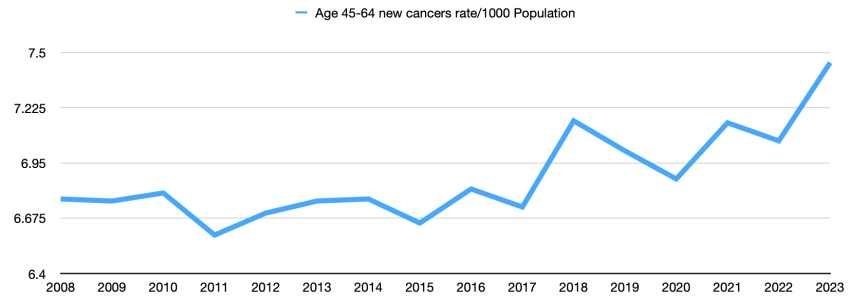
2018 cancer registrations rose due to a cancer screening drive
Prostate is the most common cancer for men and breast for women. From 2015 to 2018 Health New Zealand instituted the New Zealand Cancer Plan which aimed to systematically increase cancer awareness and the availability of cancer screening programmes especially in regional centres which had been under serviced. One result of this intensive initiative was a dramatic rise in the number of early prostate diagnoses among mature men and a more modest spike in breast diagnoses which particularly contributed to a spike in cancer registrations in 2018 in the 45-64 age range. There were no similar new screening initiatives in 2023 for common cancers likely to significantly affect the registration totals. Therefore the 2018 spike in cancer registrations should be regarded as an outlier or anomaly, which makes the peak in 2018 significantly lower and the record 2023 cancer registrations all the more significant.
Were either COVID-19 infection or COVID-19 vaccination risk factors for cancer?
In effect, underlying cancer rates among mature working age adults appear to have been increasing significantly since the start of 2021 when the COVID-19 vaccination program began. This indicates that mRNA COVID-19 vaccination may be a new risk factor for cancer affecting the majority of the New Zealand population.
Health data from New Zealand is of particular scientific interest because more than 80% of the population were vaccinated with the Pfizer mRNA vaccine during 2021 before New Zealand suffered any COVID-19 infection due to strict border control measures.
We have previously reported on a large population study from Korea, which found relatively higher cancer rates among the COVID-19 vaccinated compared to the unvaccinated. Moreover, this was not an isolated finding, it syncs with interactions between COVID-19 vaccination and cancer found in studies of Japanese pancreatic cancer survival rates and Italian health data. It is a matter of regret that Health New Zealand have so far made no visible effort to find out if COVID-19 vaccination has been a risk factor for cancer development here in New Zealand. This is a serious issue affecting the well being of the whole of society, especially as Health New Zealand is still recommending many categories of people receive COVID-19 booster shots.
What types of cancer increased?
In 2023 the largest increases among the whole population were in the incidence of breast, melanoma and prostate cancers. The incidence of lung cancer decreased. The 2023 Health New Zealand data does not distinguish what types of cancer particularly affected which age groups. The number of cancer deaths for 2023 is not yet published. Nor are any figures available for recurrence of cancers or speed of progression of cancers which overseas reports suggest have been significantly affected during the last four years (2022-2025).
2023 NZ cancer data is a red flag which needs immediate investigation
There are many factors which influence the incidence of cancer. The 2023 New Zealand data which has been released is unfortunately insufficient on its own to draw definitive causal connections. Moreover it is two years out of date. Cancers take time to develop. There are clearly new risk factors particularly affecting mature working age people in New Zealand, but Health New Zealand has not yet undertaken investigation to uncover what these factors might be.
The increase in cancer incidence in 2023 to record high rates for mature working age people and to an unknown extent among younger age groups is a red flag that requires more detailed investigation and more rapid compilation of data for 2024 and 2025.
Anecdotal reports we have received indicate that waiting lists to see an oncologist in New Zealand are becoming longer which makes it likely that the 2023 increases are continuing into 2024 and 2025. It is vital to find out as soon as possible if this is the case. Cancer is our number two killer in New Zealand, the investigation of the causes of the novel upward trend since 2021 demands up to date and comprehensive information. This investigation should include a comparison of cancer outcomes of vaccinated and unvaccinated populations. This should be an urgent public health imperative.ve.