


spot_imgspot_img
Home Blog

Red Flag: 2023 New Zealand Cancer Data Released by Health NZ—A Record

0

Health New Zealand has released the data for new cancer registrations during 2023.

Data by age, sex, cancer type and ethnicity from 2001 to 2023 is now available and can be downloaded using the Cancer Web Tool. Please note these figures are already two years behind, we don’t yet know what has happened in 2024 and 2025. 2024 figures are not expected from Health New Zealand until the end of 2026. There are many types of cancer associated with multiple risk factors and causes. Care should always be taken when interpreting any data.

In 2023 there were an all time record 29,719 new cancer registrations. This was a rate of 5.69 cancers per 1,000 population compared to an average rate during 2015 to 2019 of 5.27. That is a 7.9% increased rate of cancer occurrence. There were 4500 more cancers in 2023 than the average for 2015-2019.

Effect of an ageing population

There is however another factor other than total population size that needs to be taken into account when interpreting cancer data. New Zealand has an aging population. Around 60% of all cancers occur among people who are 65+ in age. Because susceptibility to cancer increases with age, there is an expectation that overall cancer rates will increase as the percentage of older people in the whole population increases over time. Between 2015-2019 the average percentage of the New Zealand population aged 65+ was 15% in 2023 the equivalent figure was 16.5%.

The conventional wisdom is that increases in rates of cancer incidence are primarily due to the effect of an aging population along with any modifications due to changes in risk factors. For example any significant increase in smoking rates is known to increase cancer incidence over the longer term. So the question is: ‘Was the 2023 increase in cancer due solely to the effect of a rising and ageing population?’ Have there been any increases in cancer risk factors modifying the data? In order to investigate this question and adjust for the effect of age, the Hatchard Report conducted an analysis of cancer registrations by age bracket.

Overview of cancer incidence by age

We looked separately at age ranges 0-4, 5-24, 25-44, 45-64 and 65+.

Cancer rates among the 65+ population remained more or less stable at 21 new cases per 1000 population in 2023, a rate that has been maintained over the last ten years.

Cancer rates among 45-64 year olds rose by 8% in 2023 compared to the 2015-2019 average.

Cancer rates among 25-44 year olds rose by 2%

Cancer rates among 5-24 year olds rose by 17% and by 11% for 0-4 year olds but the numbers of cases in these two age brackets are small (around 60-70 cases per year for 0-4 and 250-300 for 5-25 year olds) ensuring these rises do not reach statistically significance.

The most notable finding is among mature working age people aged 45-64. There were 1,215 additional new cancers registered in this age group above the 2015-2019 average and 817 above 2020 (the last year without significant COVID-19 infections or COVID-19 vaccines). The rate of cancers, (7.45 cancers per 1000 population) was an historical high. The rate of cancers in this age group had been relatively stable in the ten years prior to 2018 when there was a sudden spike in cancer registrations.

2018 cancer registrations rose due to a cancer screening drive

Prostate is the most common cancer for men and breast for women. From 2015 to 2018 Health New Zealand instituted the New Zealand Cancer Plan which aimed to systematically increase cancer awareness and the availability of cancer screening programmes especially in regional centres which had been under serviced. One result of this intensive initiative was a dramatic rise in the number of early prostate diagnoses among mature men and a more modest spike in breast diagnoses which particularly generated a spike in cancer registrations in 2018 in the 45-64 age range. There were no similar new screening initiatives in 2023 for common cancers likely to significantly affect the registration totals. Therefore the 2018 spike in cancer registrations should be regarded as an outlier or anomaly which makes the peak in 2023 cancer registrations all the more significant.

What types of cancer increased?

In 2023 the largest increases among the whole population were in the incidence of breast, melanoma and prostate cancers. The incidence of lung cancer decreased. The 2023 New Zealand figures do not distinguish what types of cancer particularly affected which age groups. The number of cancer deaths for 2023 is not yet published. Nor are any figures available for recurrence of cancers or speed of progression of cancers which overseas reports suggest have been significantly affected during the last four years (2022-2025).

Were either COVID-19 infection or COVID-19 vaccination risk factors for cancer?

We have previously reported on large population studies from Korea, Japan and Italy which found relatively higher cancer rates among the Covid vaccinated compared to the unvaccinated. It is a matter of regret that Health New Zealand have so far made no visible effort to find out if COVID-19 vaccination has been a risk factor for cancer development here in New Zealand. This is a serious issue affecting the well being of the whole of society, especially as Health New Zealand is still recommending many categories of people receive COVID-19 booster shots.

There are many factors which influence the incidence of cancer. The 2023 New Zealand data which has been released is insufficient on its own to lead to any definitive conclusions. Moreover it is two years out of date. Cancers take time to develop. If there are new risk factors particularly affecting mature working age people, it is not yet clear what these factors are.

2023 New Zealand cancer data is a red flag which needs immediate investigation

The increase in cancer incidence in 2023 to record high rates for mature working age people is a red flag that requires more detailed investigation and more rapid compilation of data for 2024 and 2025.

Anecdotal reports we have received indicate that waiting lists to see an oncologist in New Zealand are becoming longer which makes it likely that the 2023 increases are continuing into 2024 and 2025. It is vital to find out as soon as possible if this is the case. Cancer is our number two killer in New Zealand. The investigation of its causes demands up-to-date and comprehensive information. This investigation should include a comparison of cancer outcomes of vaccinated and unvaccinated populations. This should be an urgent public health imperative.

Open Letter to the Directors of Health Insurance Companies

0

Sent personally to CEOs of Southern Cross, FMG, IAG, UniMed/Accuro, NIB and Partners Life

Dear Director 

Sometimes information helps us to understand puzzling situations. Business models can be very informative. It won’t have escaped your notice that the public health sector has no clear business incentive to understand what is making more people more sick more often with more serious conditions as we reported this week.

The opposite is the case with health insurance companies like yours. You have an absolute need to understand health data in great detail. Your business model, the livelihood of your employees and the returns of your investors require that you get it right. To do so, you employ actuaries. Highly mathematically competent analysts who run complex computer programmes to identify what specific factors among your client profiles are associated on average with elevated volumes and costs of claims.

In other words, you analyse the health data of your clients in great detail in order to decide what premiums people should pay. An obvious factor is age. Older people generally need more healthcare. Along with smokers and heavy drinkers, older people may need to pay more for health insurance to make things equitable and to ensure that you can meet the costs of claims. As we reported this week, you have recently announced sustained losses which have necessitated substantial increases in health insurance premiums. According to media articles, this was due to increases in volumes of claims and to increased medical costs.

Despite the lack of detail available from Health NZ, you must be fully aware of a changed profile of health outcomes since 2020. No doubt this involves an increased incidence of cardiovascular, neurological, immunological and oncological conditions which have additionally impacted the capacity of some of your policy holders to maintain employment. This has become an open secret because increased rates of illness are hard to hide. Hospitals are overcrowded, the wait times at ED or to get a specialist appointment are long. Anecdotal comments and/or leaked data we have received from doctors, hospital staff and insurance brokers are also instructive. 

The actual cause(s) of increased sickness rates is therefore a matter of grave concern. It seems likely that some of the increase in sickness rates will be associated with rates of Covid infection and/or adverse effects of prevention and treatment strategies and their sequelae. It is probable that the Covid virus likely originated in a lab, the vaccines certainly did, and therefore, whichever is at fault here, increased sickness rates appear to be associated with the implementation of novel biotechnologies.

Personalised medicine involving biotechnology poses some special challenges for health insurance companies. There are now known to be in excess of 10,000 diseases with a significant inherited or genetic component. Many biotechnology companies are involved in developing individualised gene therapy procedures to tackle these illnesses. Problems arise for a number of reasons as explained and referenced in our article “The Big Debate: How Many New Doctors Will NZ Need if the Gene Technology Bill is Passed?”: 

  • The costs involved are very high. A recent trial of treatment for sickle cell disease for example cost around NZ$5 million per person. CAR T cell therapy costs almost $1 million per person.
  • The success rates are low. The sickle cell trial had a one year success rate of just 22%. CAR T cell therapies have one year success rates around 50%. 
  • The adverse effects are significant and serious. They occur at high rates. There are literally dozens of critical steps involved in gene therapies which all carry specific risks. 
  • The long term prognosis and risks of these novel therapies is unknown at this stage. In some cases it may involve a lifetime of recurring treatment.

Therefore the current direction of medicine and the projected passage of the Gene Technology Bill should be of concern to health insurance companies. As we discuss in our article “A Very Important Read: What is the Solution to NZ’s Health Crisis“, there are many well researched preventive self healthcare strategies with very large effect sizes and virtually no side effects which could help to address the current health crisis which could be encouraged and promoted by health insurance companies to great effect.

I understand that insurance companies are careful to protect the privacy of their data. Despite this, you are in possession of very important summary and specific information which could help shape NZ Health policy. If you are aware of any data which shows that there have been any recent sudden increases in specific medical conditions, then there is an imperative to investigate and share any information whether positive or negative with the public. Especially as Health NZ is continuing to promote Covid vaccination for some people whilst maintaining its safety.

We note that the US FDA and CDC are starting to ask serious questions about Covid vaccine safety. This is quite rightly a matter of public record and debate. Some mainstream publications in the US like The Atlantic have started to roll back their previous endorsement of Covid vaccination safety in the face of concerning data. Similarly US universities who mandated Covid vaccination for students and faculty have begun to issue legally worded retractions that fall short of apology, but admit serious adverse effects and deaths. 

Here in NZ it has been remarkable that the government, health authorities and the media have continued to constitute a united front maintaining Covid vaccination safety. They have done so despite the unprecedented rates of adverse effects reported to CARM and the disturbing results of recently published studies like the very large population wide studies conducted in Korea and Japan for example. In other words, they are failing to investigate potential problems in the face of accumulating evidence.

There is a need for an open public debate in our country and access to source data for demonstrably independent qualified researchers. As a director of a health insurance company with access to fully analysed health data, you can play a key role in initiating and opening up this debate. At this point, any failure to investigate vital information germane to public health planning and individual choice is not in the public interest or anyone’s individual interest.

I trust you will consider this request very seriously. Please share this email with your leadership team. I and colleagues are available to discuss any of these issues with you in person or to provide more further information. I was previously a Director at Genetic ID, a global genetic safety testing and certification company. I have lobbied governments on health strategies and biotechnology safety. Due to rapid changes in health policies and procedures, the time has come to consider the facts in the light of up to date comprehensive health data rather than simply relying on prior viewpoints.

Yours sincerely

Guy Hatchard PhD

A Very Important Read: What is the Solution to NZ’s Health Crisis?

0

This is not a doom and gloom article, it documents the extensive benefits of natural, cost effective preventive approaches to health which can help to solve our national health crisis. It contains new information. But first let’s briefly review problems that need solving and contrast the restrictive and blinkered New Zealand approach with the latest safety protocols being rapidly introduced in the USA health system.

Last week an article in Stuff newspaper was entitled ‘Horrified – doubled overnight’: Price hikes force people to rethink health insurance. It reported that health insurance premiums have rocketed sky high, in some cases almost doubling. This is not due to unfair profiteering as some have claimed. Southern Cross Health Insurance for example made losses of $52 million in the year to June 2025, $88 million in 2024 and $17 million in 2023. Health insurance companies are facing up to the reality of increased sickness rates which have led to record high numbers of claims coupled with rising health costs. Southern Cross saw a 16% rise in the number of claims and a 14% increase in costs in 2025. While health insurer UniMed reported a staggering 53% increase in the volume of claims in 2025 compared to 2024 and a 55% increase in the value of claims. A double whammy.

Our government is also struggling to come to terms with increased sickness rates which have followed on from the tail end of the pandemic. Government expenditure on healthcare in 2024/25 amounted to $30 billion about 18% of its total revenue. The average household in New Zealand spends an additional $50 per week on healthcare—in total $5.2 billion. Private health insurance premiums soak up a further $3 billion. The government spends a further $2.6 billion on disability support. ACC (accident compensation) cost $7 billion in 2024/2025. In all about $48 billion is spent on healthcare in NZ. Healthcare costs about $9200 for every man, woman and child each year, or $37,000 for a family of four. In total approximately 11% of our GDP (the entire economic activity of the nation) or 20% of the per capita average income.

Despite this massive expenditure, our health system is failing us.

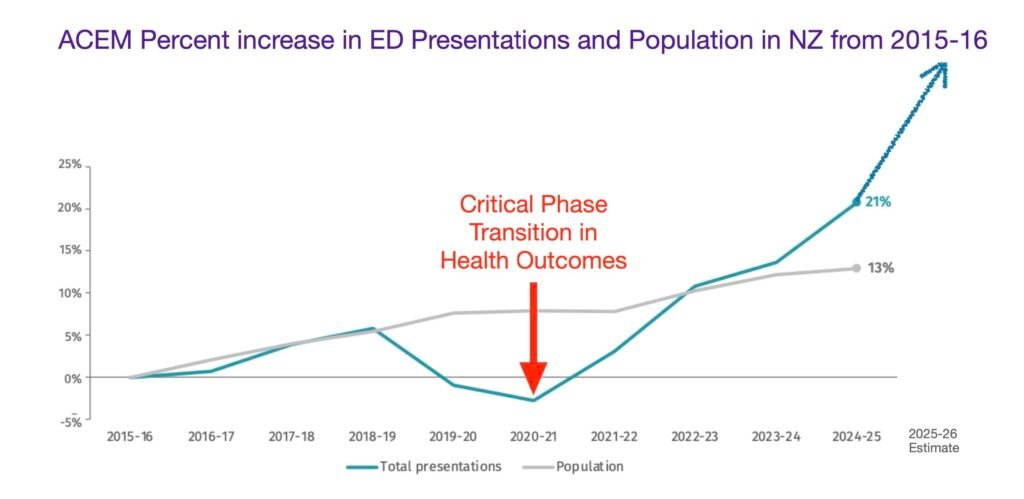
As we reported recently St John Ambulance emergency call outs stood at a record high in August leaving hospitals struggling to cope. There are unacceptable wait times to see a specialist. 2025 emergency callout volumes are running 60% above pre-pandemic levels. Insurance data indicates that health care premiums are rising because people are falling sick more often and requiring more serious interventions.

Put very simply and starkly we are falling more seriously ill more often from a wider range of more complex illnesses.

COVID-19 and the response to COVID-19 initiated a sea change in the disease profile of the whole population. New Zealand health authorities and the government have failed to come to grips with the changed health landscape. In contrast the US FDA is accelerating the introduction of new medical safety protocols. Endpoint News is the biopharma industry news outlet, its December 11 briefing covering just one week of reforms reported:

  • The FDA’s investigation of COVID-19 vaccine safety in children has expanded into adults, — a significant widening of scope amid the Trump administration’s plans to rethink US vaccine policy.
  • The FDA has set a higher bar for new CAR-T cell cancer treatments requiring a control group (unbelievably not previously required) and details of survival rates.
  • The FDA no longer requires a Hepatitis B shot at birth because of safety concerns.
  • The FDA is revisiting approval of RSV antibody medication following safety concerns.

In contrast, the New Zealand government is proceeding on December 11th with its prosecution of whistleblower Barry Young who released damning data of deaths proximate to COVID-19 vaccination. He realised the data raises serious questions about COVID-19 vaccine safety. He should have been appreciated and the data analysed rather than being hidden.

How could this be happening? If you want to look at an instructive model of government incompetence watch The Days on Netflix which documents events at the Fukushima nuclear power plant following the devastating tsunami in 2011. Government officials are depicted struggling to come to grips with the magnitude of the dangers and the technicalities involved, as the instability of the reactor rapidly approached a critical phase. This parallels the failure of our government and medical establishment to come to grips with the unprecedented massive rates of adverse events recorded at CARM following the COVID-19 vaccine roll out.

Eventually, the Japanese government decided to phase out nuclear power generation because of safety concerns in the earthquake prone nation. But now fast forward to the present day and you can see how the allure of novel technology distorts safety considerations. Unbelievably, the amnesic Japanese government has decided to recommission nuclear plants to meet the power hungry needs of AI databank processing centres. In a parallel situation, despite the vaccine injuries and deaths and the likely lab origin of COVID-19, our government has failed to learn lessons. It has introduced the Gene Technology Bill which will deregulate biotechnology experimentation and downgrade existing safety regulations. This is thankfully being widely opposed by a large segment of the public, some significant industry players and the New Zealand First political party

What are the Alternatives?

Despite the health crisis, broad spectrum approaches to population-wide healthcare with massive positive effect sizes are readily available and well researched. These approaches are cost effective, preventive and they can be easily implemented and self managed in the home. Incredibly, they are not covered by standard medical training.

There are five factors which each person can manage for themselves which can radically improve health outcomes. The more commonly appreciated are food, behaviour, experience and thinking, but all of these are controlled by our conscious choices. Thus the management of consciousness itself is the fifth factor.

Food

Our health relies on our diet. Adequate nutrition is essential for good health. Numerous studies have shown that a diet rich in fresh fruits and vegetables can have a massive preventive effect on the incidence of cancer, cardiovascular disease, autoimmune conditions and other illnesses. The benefits are not only significant, they are very large, including increased longevity. Research published in 2015, with 150,000 participants over 32 years found that vegetarians live longer. Even a tiny 3 per cent increase in protein from plants led to a huge 12 per cent drop in risk of death from cardiovascular-related disease. A study published in the BMJ in 2021 found that “Participants with COVID-19 who reported following ‘plant-based diets’ and ‘plant-based diets with pescatarian elements’ had 73% and 59% lower odds of moderate-to-severe COVID-19 severity, respectively, compared with participants who did not follow these diets.”

For those wondering what you could introduce into your diet, the UK Telegraph published “The best beans for your health, the superfood you should be eating daily”. The article documents the protein-rich variety of options full of gut friendly fibre.

Despite the health benefits of natural foods, our population-wide nutrition profile is being systematically degraded by the availability and promotion of ultra processed foods (UPFs) which not only lack essential nutrients but also contain toxic ingredients. Research published in the BMJ in 2024 entitled “Ultra-processed food exposure and adverse health outcomes: umbrella review of epidemiological meta-analyses” found direct associations between exposure to UPFs and 32 health parameters spanning mortality, cancer, and mental, respiratory, cardiovascular, gastrointestinal, and metabolic health outcomes.

Widespread pesticide and herbicide use is also known to pose severe risks to health. For example on November 28th 2025 a key scientific study which was published in April 2000 on Glyphosate safety was withdrawn by the journal Regulatory Toxicology and Pharmacologyafter it was discovered that the study was actually ghost-written by Monsanto employees who ignored the results of numerous long-term chronic toxicity and carcinogenicity studies available at the time. For decades the withdrawn study has been relied on by the agro industry to fend off safety concerns. New Zealand has some of the highest rates of agricultural glyphosate use in the world, for example allowing pre-harvest desiccation spraying which is banned elsewhere. Recently our government actually increased the allowable glyphosate residues in foods to prepare for increased glyphosate use paired with GM crops.

Fortunately, in organic agriculture, the use of pesticides is restricted giving the public options. A 2017 study found organic food consumption reduces the risk of allergic disease and obesity. Epidemiological studies have reported adverse effects of certain pesticides on children’s cognitive development at current levels of exposure.

Our article “Major Health Alert: the Extraordinary Genetically Modified Invasion of Our Supermarkets by Stealth” has explained how our food system is now also under threat from residual toxic contamination resulting from the use of genetically modified microorganisms (GMMs) and GM ingredients.

Herbs have a long history of safe and effective use in medicine, but modern pharmacy-based medicine has wrongly tended to dismiss their value. For example a randomised placebo trial published in April 2021 found improved outcomes for COVID-19 positive patients treated with a range of Ayurvedic Indian herbal preparations. A 2024 review concluded that: “Herbal medicines worked to treat COVID-19 through antiviral, anti-inflammatory, and immunomodulatory mechanisms.”

The response of the government is lamentable and counter productive. They apparently have no interest. The government has failed to adequately educate the public and youth about healthy food choices. It has failed to rein in misleading food labelling which often wrongly describes sythethically engineered food as natural or free of additives. It has failed to ban the use of toxic agricultural chemicals or incentivise sustainable farming practices. It has failed to assess studies documenting the toxic effects of GMMs in the food processing industry. Instead it has been deregulating gene technology, wrongly categorising many gene editing techniques and food production methods as inherently safe. The government is planning to build more academic institutions to train doctors but medical curricula still do not include sufficient training in the principles of general nutrition, micronutrients and herbal medicine.

Behaviour

Early on in the pandemic it became apparent that healthy lifestyle choices had a large positive impact COVID-19 outcomes. A study conducted in the UK found that shift workers, who typically suffer from disrupted bio clocks and fatigue, were three times more likely to be hospitalised with COVID-19. A study of 48,000 adults in California published in the BMJ found that regular exercise reduced the risk of severity, hospitalisation, and death from COVID-19.

The beneficial effects of exercise have been well-documented for a range of improved metabolic and cardiorespiratory fitness-related outcomes. Regular exercise is essentially considered a non-pharmacological polypill for patients with certain comorbidities. Therapeutic exercise can be adopted to prevent, manage, and treat diseases such as obesity, type 2 diabetes, cardiovascular disease, aging-related muscle atrophy, and certain cancers.

Lighter exercise regimes can be just as beneficial if not more so. A 2024 article entitled “Neurobiological and anti-aging benefits of yoga: A comprehensive review of recent advances in non-pharmacological therapy” found Yoga practices influence critical biological processes, including reducing oxidative stress, modulating chronic inflammation, enhancing immune function, and preserving DNA telomere length—all key markers of cellular aging. Additionally, Yoga practices including postures, breathing exercises and meditation contribute to improved cardiovascular health, musculoskeletal strength, and mental well-being, fostering a comprehensive approach to healthy aging. The study underscored the potential of integrating the non-pharmacological strategies into daily routines to enhance resilience against aging, improve quality of life, and extend healthspan.

A 2023 study reports the benefits of regular walks for health, concluding: “Walking decreases the risk or severity of various health outcomes such as cardiovascular and cerebrovascular diseases, type 2 diabetes mellitus, cognitive impairment and dementia, while also improving mental well-being, sleep, and longevity.”

A 2020 review of the benefits of the Chinese movement system Qigong assessed the results of 886 clinical studies and found improvements in a range of conditions including diabetes, chronic obstructive pulmonary disease, hypertension, stroke, cervical spondylosis, lumbar disc herniation, insomnia, knee osteoarthritis, low back pain, and osteoporosis.

Experience

Sunshine, fresh air, a change of pace, friendship, laughter, beauty, and family support all positively influence health outcomes. For example a 2023 review found that epidemiological studies from the United Kingdom and Sweden link sun exposure with reduced all-cause, cardiovascular, and cancer mortality. Conversely, overcrowding, air pollution, environmental toxins, a stressful job environment, poverty, unemployment, smoking, vaping, off gassing from toxic materials in the home, tiredness and overuse of alcohol all impact both physical and mental health negatively. Numerous studies indicate that even a poor quality chair or an older bed mattress can have a disastrous effect on health and pain levels.

Our government has wrongly assumed that a policy which intensifies urban housing concentrations will benefit the economy. Instead it is increasing stress and air pollution and reducing quality of life.

Thinking

Use of the brain is strongly related to mental and physical health including timely unfoldment of developmental stages, neurological networks, and thinking skills, along with a measure of protection from dementia occurrence and progression.

A 2024 review article found that positive and negative mindsets have a significant impact on disease progression and recovery. The study recommended a paradigm shift in medical practice, it advocated for a comprehensive approach to medical care that recognises the power of thought in promoting patient wellness.

Some technological developments have negatively impacted our capacity for rational thought. For example over reliance on calculators has reduced numeracy and the capacity to understand data. We shudder to think of the future effect of AI on the capacity for rational and creative thought.

A study covering 14 years published in 2020 found that reading activity prevents long-term decline in cognitive function in older people. Other research highlights reading’s health benefits, including significant stress reduction, lowered blood pressure, improved sleep, enhanced cognitive function, improved memory, increased empathy, and reduced risk of depression and loneliness, with some studies linking consistent reading to longer lifespans by promoting mental and emotional fitness. Reading offers a form of self-care by building neural connections, and fostering social understanding through narrative immersion, making it an affordable tool for holistic well-being. Yet education policy has de-emphasised reading in favour of video material found in films and TV. Studies have found that reading books is more effective at stimulating the imagination compared to watching images and stories unfold on screen.

Consciousness

The defining characteristic of life is awareness or consciousness. We are awake—we remember, we experience, we decide, we act, we eat. Consciousness is the fulcrum point upon which our future turns.

Development of consciousness should be a key component of healthcare. A 1987 field study entitled “Medical care utilization and the transcendental meditation program compared the medical insurance utilisation statistics of 2000 practitioners of transcendental meditation to a normative database of 600,000 people enrolled in the same scheme. The study found that

The benefits, deductible, coinsurance terms, and distribution by gender of the TM group were very similar to the norm, yet the TM group had lower medical utilisation rates in all categories. Inpatient days per 1000 by age category were 50.2% fewer than the norm for children (0-18), 50.1% fewer for young adults (19-39), and 69.4% fewer for older adults (40+). Outpatient visits per 1000 for the same age categories were, respectively, 46.8%, 54.7%, and 73.7% fewer. When compared with five other health insurance groups of similar size and professional membership, the TM group had 53.3% fewer inpatient admissions per 1000 and 44.4% fewer outpatient visits per 1000. Admissions per 1000 were lower for the TM group than the norm for all of 17 major medical treatment categories, including 55.4% less for benign and malignant tumours 87.3% less for heart disease, 30.4% less for all infectious diseases, 30.6% less for all mental disorders, and 87.3% less for diseases of the nervous system. However, the TM group’s admission rates for childbirth were similar to the norm.

The effect size of meditation on health conditions is very large compared to drug therapies. For example regular meditation is estimated to be thirty times more effective than statins at preventing cardiac illness and free of side effects. The range of health benefits of meditation is very broad indeed, indicating a holistic effect on physiology orchestrated from the field of self-referral consciousness. To discover more about the benefits of meditation, our Substack article on Consciousness-Based Alternatives and our presentation to the Scientific and Medical Network available on YouTube contain more detailed information. Meditation can play a key role in developing healthy choices naturally without effort. Studies have shown that regular meditation precipitates a preference for more healthy choices including reduced smoking, drinking and better food choices.

It is a matter of deep regret that our medical authorities have consistently rejected natural, scientifically verified means of maintaining and promoting health that are effective and low cost, whilst being free of side effects. I can vividly remember meeting with Dr John Hiddlestone, New Zealand Director General of Health in the early 1980s. He enthusiastically investigated and embraced research demonstrating the potential of meditation as a healthcare strategy, but was dissuaded by his administrative colleagues. In the 1990s the director of the innovative healthcare initiative at Health New Zealand acknowledged the strength of the research evidence but cynically confided to me that doctors would never embrace an alternative to pharmacological medicine because the improved health outcomes and participation of alternative practitioners might reduce their earning potential. These were early opportunities lost. By now the published evidence in the fields of food, behaviour, experience, thinking and consciousness is far stronger, but the resistance within the medical profession to new scientific evidence concerning the efficacy of natural alternative approaches to health has become even more entrenched. The use of the word ‘alternative’ is actually a misnomer. Our everyday health is already 95% maintained through our diet, exercise, behaviour, exposure to fresh air, pure water and sunshine and our mental stability and adaptability. It always has been. Adopting these principles in medical care and education should be the next step in meeting the health crisis that has engulfed our nation.

Open Letter To The Royal Commissioners on Covid-19 Lessons LearnedPhase 2

0

Dear Grant Illingworth KC and fellow Commissioners

I understand from your latest panui that you are currently assessing the
evidence you have gathered in order to prepare your final report. Although
the Hatchard Report submitted evidence to the Commission, our request for
a meeting with yourselves was not granted. As I was in a unique position to
offer invaluable information to the Commission, I believe an opportunity was
missed. I would like to set the record straight in a last minute sincere attempt
to serve the needs of justice.

In March 2021 immediately prior to the Covid vaccine rollout, I was
personally invited to correspond with senior individuals who had been
appointed to advise the government. These included a leading
epidemiologist, a well known business leader and a member of the Skegg
Committee. My academic background includes the use of sophisticated time
series analysis to test for causal factors in social and economic data. My
early input was well received. For example Professor Michael Baker replied
to one of my comments:

Thank you for that very lucid description of our current state of knowledge
around Covid-19 and the uncertainties – which are large. I agree about the
importance of trying to keep an open, evidence-informed debate about future
options.

I was well aware that mRNA vaccine technology was both novel and already
well recognised in the scientific literature to involve unique risks. Early on I
took advantage of my contacts in the global biotechnology research sector
to gather advice about these risks and to find out more about Covid origins.

There was a consensus among my contacts, who were actively doing
research on genetic medicine, that Covid originated in a laboratory, but there
was a reluctance to go public with this information for fear of losing their
position. It was also apparent that despite the known risks of mRNA
vaccination technology there was a reluctance to dismiss its use, rather my
contacts believed the severity of the early variants circulating overseas
dictated Covid vaccination should be a matter of informed personal choice.
In other words, the risks should be a matter of public knowledge and
discussion, and the effects of vaccination should be deeply researched and
assessed. This was the extent of my understanding as my correspondence
with government advisors commenced—I believed we should err on the side
of caution. Government policy was keeping Covid out of the country which
could have bought us time to assess the safety of the vaccine as it was used
overseas before we rolled it out here in NZ. In the pressured atmosphere of
the early pandemic this opportunity was missed.

It immediately became apparent to me that because NZ was almost
completely free of Covid infection, due primarily to border controls, contact
tracing and social isolation measures, we were in a unique position to assess
any effects of the novel mRNA vaccine in the absence of confounding
factors related to Covid infection. No other country in the world had this
opportunity to the degree NZ enjoyed. Therefore I took the responsibility of
my contact with senior government advisors very seriously indeed. As the
vaccine rollout began, I monitored published scientific papers on Covid and
used my data skills to assess any vaccine effects.

Early on I pointed out that lifestyle factors including diet and exercise, and
alternative medical strategies to combat comorbidities could critically affect
Covid outcomes and should be a factor in government policy to ensure a
satisfactory long term public health outcome.

But over the second quarter of 2021, as the vaccine rollout gathered pace,
my correspondence with government advisors revealed that there was an
overwhelming consensus that vaccination would contain Covid, despite the
fact that overseas Covid data was not supporting this contention. By July a
number of studies and assessments in USA and Israel (with 59% of the
population vaccinated at the time) revealed that Covid vaccination did not
stop transmission and that any effectiveness at preventing hospitalisation fell
dramatically within 10 weeks of vaccination and disappeared entirely within
180 days.

The reaction of the government team was instructive. A member of the
Skegg Committee wrote to me suggesting that Covid was being spread in
the general population by children who at that stage were not yet
vaccinated. This suggestion did not have any supporting data, it merely
reflected a predetermined policy to get everyone vaccinated as soon as
possible. I wrote back warning about the dangers of an overconfidence in
Covid vaccination that did not fit the actual data.

In August a preprint paper reported that the natural immunity acquired
through Covid infection was 13 times more effective at preventing reinfection
than Covid vaccination in the absence of prior infection. I circulated this
among government advisors. The Skegg Committee member wrote back:

A protective immune signature is often elusive and vaccines are actually
quite primitive in design, and often don’t need to be anything other than that.
For covid vaccination, we are actually still in the first generation and there will
be lots of improvements – to dosing, dose interval, boosting and adjusting for
variants. The fact that one has to give them to everyone to protect the few
from falling victim (death) is unlikely to ever change I wouldn’t have thought.
And the chances of other ‘interventions’ having anything like their protective
effect is remote in my view.

In other words, even though data was showing that mRNA Covid shots were
not proving effective, there was such a deep seated faith in the principle of
vaccination that the actual data and the novel nature of mRNA vaccines was
being ignored in the expectation that vaccine developers would get it right in
the end. But by September it became clear that data showed Covid
vaccination was not preventing deaths. I emailed the government team:

“I ran a linear regression for 190 countries between percentage of the
population vaccinated and deaths per million during the last seven days. There is no significant correlation (+0.034)…..I believe this points to a general
principle that: it is factors and policies other than vaccination which
primarily affect outcomes in a nation. Determining those factors is critical
in understanding the pandemic and its possible solutions. From this point of
view I am increasingly of the opinion that the current government messaging
is becoming misleading. The majority emphasis on vaccination targets is
giving the impression that a high level of vaccination alone will guarantee
freedom from Covid.”

My early correlation finding was subsequently supported by a published
study
. The Skegg Committee member wrote back to me:

I think you are right that studies have also shown that high vaccine coverage
will not alone contain outbreaks. And that, given our still low 2-dose vaccine
coverage, we are presently in a very risky situation.

In other words, in his opinion the solution to the lack of Covid vaccine
effectiveness was more frequent mRNA vaccination. This did not appear to
make sense, especially as reports of high rates of vaccine adverse effects
were multiplying. Studies were beginning to be published showing that the
risk of Covid infection for younger age groups was very low but the risk of
adverse effects of Covid vaccination might be higher. These were red flags
which were being ignored here in NZ.

In October I received a reply from the Skegg committee member to my
concerns about a teenage girl who had died suddenly following Covid
vaccination. He dismissed this as a likely adverse effect of the oral
contraceptive, not a possible effect of Covid vaccination. I raised other
similar cases of sudden death following Covid vaccination but by the end of
October I was excluded entirely from email interaction with government
advisors. My input was cancelled. By this time the government was set on a
policy of vaccine mandates, despite the growing evidence of harm. Universal
Covid vaccine mandates for some professions and movement restrictions on
the unvaccinated were extended during November. At this point I believed
there was an overwhelming public interest to raise my voice, to go public
with my concerns and put analysis of NZ Covid data on a scientific footing.

Data for weekly all-cause deaths by age was available. Weekly Covid
vaccine totals by age were being announced. It was therefore possible to
undertake a time series analysis to determine whether increases in vaccine
rates were followed by increases in deaths. I undertook this analysis for the
60+ age cohort. I compared weekly vaccination numbers in New Zealand
with weekly deaths (all causes) for the 60+ age group between 7 March 2021
and 31 October 2021. This period corresponded to the exclusive roll out of
the Pfizer Covid-19 vaccine. There were very few cases of Covid-19 active in
the community during this period and therefore the effect of the Pfizer Covid
vaccination could be studied largely free of the confounding factors of Covid
deaths. My time series analysis found a positive effect of vaccination on
deaths (all causes) at a lag of one week (t(33) = 1.74, p = 0.045 one-tailed).
Tests showed the results cannot be plausibly attributed to spurious
regression due to nonstationarity. The analysis found that vaccination was
associated with 434 additional all cause deaths during the week following
vaccination among individuals aged 60+. This age cohort received a total of
2.8 million vaccine doses during the experimental period. The finding of
additional deaths is roughly consistent with available reports of all cause
deaths proximate to vaccination that were reported. The full text of the
analysis is available at Research Gate

There are limitations to this analysis. There is no doubt that the collection of
vaccination totals by week would have been to an unknown extent subject to
haphazard data collection and recording due to the rush involved, but any
existence of a relationship between Covid vaccination and all cause mortality
in the absence of Covid infection should have been a red flag. Moreover the
possible association should have been obvious even to a casual observer of
the above graph which was widely publicised at the time and fully available
to those in government and the medical establishment who should have
been assessing the possible effects of the Covid vaccine rollout.

As many others will have pointed out to you, the government became tardy
in publicly acknowledging the risks of Covid vaccination. For example it was
not until fully six months after the risk of myocarditis and pericarditis was
well known in scientific literature that Dr. Ashley Bloomfield wrote to DHBs to
warn them. The failure to alert the public to proven risks had dire
consequences. In 2022 a prospective study in Thailand found 30% of
teenagers suffered adverse cardiac symptoms following mRNA vaccination.
In April 2023 we reported data from the Wellington region showing an 83%
increase in hospitalisation for heart attacks
. In 2024 we reported a
staggering increase in ED visits for chest pain among people under 40 and a
188% rise in mortality risk among NZ teens following Covid-19 vaccination.
More recently, high quality large population studies have found relatively
higher cancer rates among the Covid vaccinated compared to the
unvaccinated
. In 2025 our St John ambulance emergency calls remain at
record highs, 60% above pre-pandemic levels. Health insurance premiums
have doubled over the same time frame. Our health system is overwhelmed.

These alarming health statistics result from some key mistakes that were
made in the early years of the pandemic that could have been avoided which
I summarise as follows:

A. There was a failure to take account of the known character and depth of
the serious risks posed by novel genetic interventions as used by the Covid
vaccines. The adverse outcomes of past gene therapy trials and the results
of prior animal studies were ignored. Warnings of some internationally
prominent microbiologists were wrongly dismissed as conspiracy theories.

B. Instead, authorities followed a policy which naively and wrongly assumed
the risks and possible adverse effects of mRNA vaccines were similar to
prior traditional vaccines. In this way they limited the number and type of
conditions which might conceivably be related to Covid vaccination. They
dismissed as unrelated high rates of red flag adverse vaccine reactions
including neurological effects, kidney damage, immune deficiency,
psychological effects, cardiac issues and sudden deaths which were
occurring at unprecedented high frequencies.

C. The absence of any studies of the longer term effects of Covid vaccines
should have led to rigorous pharmacovigilance monitoring. Instead
authorities assumed that any adverse effects would only surface during the
first 21-30 days following vaccination, thus crippling their potential to assess
and understand potential Covid vaccine outcomes including cancers. Border
controls and contact tracing largely excluded Covid infection in NZ during
2021, giving NZ a unique opportunity to assess the effects of Covid
vaccination in isolation from Covid infection. This opportunity was lost.

D. Authorities actively sought to suppress and discredit those asking
questions and raising concerns on both local and international platforms,
including valid scientific results and discussions. They made repeated public
assurances of safety and efficacy in the face of contrary evidence and
sought to control media and social media content and discussions,
apparently in order to suppress Covid vaccine hesitancy. They severely
disciplined doctors offering informed consent.

E. The government sought scientific advice mostly from committed vaccine
advocates who had a very limited understanding of gene technology. They
too readily accepted the clearly biased communications from Pfizer advising
safety and positive trial outcomes. Crucially, ignoring the alarming details of
wide scale high frequency adverse events contained in the document 5.3.6
Cumulative analysis of post-authorization adverse event reports of Pfizer
bnt162b2 received through 28-feb-2021
, a version of which our government
received in 2021 and whose implications have been thoroughly analysed in
the published scientific literature
.

F. In assessing the massive volume of scientific publishing on Covid-19
which runs to many more than 100,000 papers, there was a failure to take
account of the known hierarchy of evidence. The results of prospective
studies, time series analysis, studies of large populations, studies comparing
outcomes of vaccinated and unvaccinated populations and studies
examining longer term outcomes should have taken precedence. If this had
been followed, dangers would have been apparent and problems averted.

G. As time went by and evidence of harm in the population both here and
overseas began to accumulate, authorities attempted to limit access to key
NZ source data especially concerning specific parameters such as vaccine
status, cardiac disease, cancer, excess mortality, etc. Those figures that
remained accessible or were leaked, painted a very grim picture of
accelerating ill health since 2020 that continues to be ignored by Health NZ
or erroneously blamed on factors that have remained largely unchanged
since 2020. Yet it has become ever clearer that the rate of Covid vaccine
injuries reported to CARM is only the very tip of the iceberg. A Covid death
whistleblower Barry Young is still facing prosecution. Doctors raising
questions about Covid vaccines are still being censored

It is apparent that long term public health outcomes have been harmed by
the combination of Covid infection and vaccination. Both of these almost
certainly resulted from biotechnology experimentation. The failure of the
government and Health NZ to come to grips with the implications of the
health data needs to be exposed and discussed publicly. Your role as
Commissioners requires a full examination of the scientific data that has
been so far ignored here in NZ. I remain available to discuss these issues,
they are within the Commission’s terms of reference. They should not be
omitted from your final report. This is a matter directly affecting public health
and longevity.

Yours sincerely
Guy Hatchard PhD

Guy Hatchard PhD Biography

Guy Hatchard is the creator and principal contributor to the Hatchard Report.
He has been a life-long advocate of food safety. He was formerly Director of
Natural Products at Genetic ID, a global food safety testing and certification
company now known as FoodChain ID. Genetic ID developed techniques to
test for the presence of genetically modified organisms in food and provided
services to bulk food trading companies like ADM, Cargill, and many others
in order to facilitate access to export markets and increase consumer trust.
He has presented his findings to governments and industry leaders around
the world. He appeared before the NZ Royal Commission on Genetic
Modification and has been a key figure in discussions since 2017 which
eventually led to the repeal of the Natural Products Bill. He has written a
book Your DNA Diet which is available from Amazon.

He received his BSc Hons. from the University of Sussex, UK, in Logic and
Theoretical Physics with a special focus on the scientific method. He
qualified with a Certificate in Teaching from Canterbury Teachers College,
Christchurch. His MA thesis at Maharishi International University (MIU), Iowa,
analysed outcomes of mastery learning in Mathematics. His PhD thesis in
Psychology at MIU investigated the impact of human factors on national
competitive advantage using time series analysis. Maharishi International
University (MIU) is fully accredited by the Higher Learning Commission (HLC)
which is recognised by the US Department of Education and the Council on
Higher Education Accreditation (CHEA). It incorporates principles of
consciousness-based education (CBE). CBE includes traditional subjects
while also cultivating the student’s potential from within. He has published
papers in peer reviewed journals and was the keynote speaker at the 1996
annual conference of the British Psychological Society on Crime.

Provisions of the Gene Tech Bill Are Being Introduced by Stealth.

0

Frustrated by questions being raised by some political parties which are currently stalling the Gene Technology Bill, government appointed regulators have gone ahead to liberalise the laws around genetic modification in the New Zealand food system without parliamentary approval.

These regulatory changes mirror some of the proposals in the Bill and effectively jump the gun, bypassing the need for parliamentary scrutiny and approval. This gives us a taste of what will happen if the Bill is passed and a single regulator is able to take all decisions about genetic modification.

On 2nd September the Australia NZ Food Standards Code P1055 was updated to change the definition of a genetically modified food. Novel foods produced using so-called  ‘new breeding techniques’ such as some involving CRISPR gene editing are no longer classified as genetically modified (GM). Effectively these novel foods will no longer be identified at any point in their production. Thus they escape any requirement for compulsory labelling, denying the right of consumers to know what they are eating and the possibility of tracing any health effect in the food chain.

This is completely outside the remit the government has from the public. They should not be forcing through changes of this type. This is not even a nanny state provision, there is no public benefit. It is simply a removal of a basic right to know what we are eating and disregards any possible effect on public health.

‘New breeding techniques’ are defined as any procedure of gene editing which doesn’t introduce ‘novel DNA’. In other words, if the genes of a plant or animal are removed or rearranged using gene editing techniques, foods produced from this are no longer classified as GM. They are now regarded as equivalent to conventional breeding. The problem with this definition, as we have previously reported, is the fact that CRISPR gene editing results in unintended Double Strand Breaks (DSBs) in the DNA and off target chromosomal rearrangement, both of which can result in altered nutritional profiles and unintended enzymatic actions which can have health effects.

This is one more level of genetic modification which is being introduced into the food chain by stealth. We have discussed others in our article Major Health Alert: the Extraordinary Genetically Modified Invasion of Our Supermarkets by Stealth for example. This article detailed research identifying toxic residual contamination resulting from the widespread use of genetically modified microorganisms as food processing aids. Without strict labelling laws, food companies are reluctant to identify or label any GM content in their products. In some cases New Zealand food producers are unaware of the origin or nature of GM ingredients they are importing and using during food production. In other cases they know but they are anxious to hide their use.

To illustrate the problem, we phoned cheese manufacturers and asked about the rennets they are using. If cheese rennets are labelled ‘animal rennet’ they are not genetically modified, but these days few New Zealand cheeses use this product. Instead cheeses are variously labelled as containing ‘rennet suitable for vegetarians’, ‘vegetarian rennet’, ‘non-animal rennet’, ‘microbial rennet’, etc. A problem arises because most New Zealand cheeses are manufactured using GM rennet made by Pfizer called Chymosin, which current labelling laws allow to be labelled using any of the above innocuous sounding terms. GM rennet is a powerful coagulant chemical designed to precipitate solids in solution which for example could affect physiological conditions including blood clotting, migraines, haemorrhoids, and varicose veins.

We found a variety of responses to our phone and internet enquiries. Whitestone cheeses made in Oamaru, Mahoe cheeses in Northland, and Hohepa Cheeses made in Hawkes Bay assured us they did not use Chymosin, instead using microbial rennets made from plants. There are probably others including some imported cheeses that still use natural processes.

Barrys Bay Cheese in Canterbury admitted exclusively using Chymosin. Mainland cheese consistently avoided answering the question so you can safely assume that they are using GM rennet unless animal rennet is specifically identified on the label as it is with their Tasty cheese. There are other cheese manufacturers and it is always best to inquire carefully. Be sure to ask what they are actually using, some people go to great lengths to  sound natural even if they are not.

Aside from the ambiguity of labelling, a problem arises because food manufacturers are not obliged to disclose to consumers exactly what they are putting in food. So the cheese manufacturers can simply not respond to any consumer inquiry and escape any censure, as Mainland consistently does.

This problem is not confined to cheese, lax labelling laws are allowing the content of foods and food processing aids to be changed without any alert on labels. To test this we contacted the top two home bread yeast brands Tasty and Edmonds to ask which genetically modified version of Saccharomyces cerevisiae (yeast) are they using, Sc1.0 or Sc2.0? Neither company was able to reply to our question over the phone, nor did they respond to our follow up email. For the record Sc2.0 is more highly modified but the construction of both types raises some serious health questions as we outlined in our article Give Us Our Daily Bread.

As a very wide range of food ingredients are rapidly changing and becoming subject to genetic modification, our labelling laws need to embrace clarity and full disclosure. 

Yesterday I almost bought a Harker Herbal product Deep Lung Support to help shake off a persistent post viral cough, but I stopped short when I came across one ingredient labelled ‘vegetable glycerine’. I didn’t know what that was. So a little research revealed “Vegetable glycerine is made by heating vegetable oils (like palm, soy, or coconut) with water under high pressure and temperature, a process called hydrolysis. This breaks the bonds in the oil’s triglycerides, separating the fatty acids from the glycerine. The crude glycerine is then further purified through distillation to create a refined, high-purity product.” 

Vegetable glycerine is presumably added to the Harker product to help the medicine slip down the throat easily, just be aware that excessive consumption of vegetable glycerine can cause diarrhea, bloating and nausea. In other words, vegetable glycerine is not digestive or nutritive.

However, some deeper research revealed that since 2017 vegetable glycerine can be produced using batch fermentation, typically with specific types of GM yeast and a carbohydrate source. Unbelievably this process is classified as a non-synthetic, biological method of production that results in organic-certified glycerine, which is gaining attention due to consumer demand for natural products????

I called Harker to ask what sort of vegetable glycerine they were using and they answered it was probably derived from soy, something our daughter is allergic to. Harker referred us to their manufacturing plant, Midwestern Pharmaceuticals in Hawkes Bay for more information. Midwestern was very helpful and informed us that their vegetable glycerine was manufactured in Malaysia from either soy or rapeseed. The Certificate of Analysis (COA) did not say if the glycerine they were using was produced using batch fermentation or hydrolysis, so they offered to contact their Malaysian supplier and get back to us in the future. We are awaiting their email reply.

I am not singling out Harker which is a highly regarded family owned New Zealand company almost exclusively using traditional ingredients, but instead using this example to show how any possible GM origin of foods is currently disappearing as it goes through novel processing and/or crosses international boundaries on its way to NZ. On inclusion in consumer products, the origins and possible GM content or contamination are allowed to be masked by innocuous sounding names and descriptions written on labels. I want to emphasise that following our enquiry Harker has instituted a procedure to identify whether any changes have occurred at their supplier.

All the while, detailed research is showing that Ultra Processed Foods (UPFs) are a global health threat. An article published on November 18th 2025 in the Lancet is entitled Ultra-Processed Foods and Human Health. It reviews the evidence about the increase in ultra-processed foods in diets globally and highlights the association with many non-communicable diseases. It concludes:

“The rise in ultra-processed foods is driven by powerful global corporations who employ sophisticated political tactics to protect and maximise profits. Deteriorating diets are an urgent public health threat that requires coordinated policies and advocacy to regulate and reduce ultra-processed foods and improve access to fresh and minimally processed foods.”

Instead here in New Zealand we have a government and a food regulation regime that is determined to reduce transparency and consumer information, allowing newly introduced, highly processed and possibly genetically modified ingredients to escape identification throughout the food chain and on labels. This goes counter to the growing realisation that processed foods and ingredients are a source of serious illnesses including cancers and high rates of chronic illnesses like diabetes. 

The Gene Technology Bill is a stand out example of this trend, but even as large sections of the public oppose the Bill for sound scientific and economic reasons, our government along with the Australia and New Zealand Food Standards Authority is pressing ahead with regulations that obfuscate consumer information and facilitate vast changes to traditional foods without any need to inform consumers. This is frankly extreme and an absolute disgrace. The determination to facilitate these changes by hook or by crook, with or without legislation using regulations, signals a disregard for public health and a desire to facilitate an exploitative global food industry that cares very little if at all about public health.

Gene edited food using CRISPR techniques must not be allowed to enter our food chain unidentified. Traceability and accountability are key pillars of a safe food environment. P1055 needs to be repealed. Write to your MP. Do not allow provisions of the Gene Technology Bill to be adopted by stealth. This is a fundamental democratic right.

Extreme Agendas of Biotechnology Are Being Put on the Table

0

ChatGPT founder Sam Altman has joined a clutch of tech billionaires contributing to the US$30 million funding of a biotechnology business called Preventive which aims to “correct devastating genetic conditions for future children”. The US company has plans to edit the DNA of babies before they are born, a process known as human germline genetic engineering which is currently banned in 70 countries. Preventive is seeking a country which will give them permission to carry out their experiments. No doubt the Gene Technology Bill, currently awaiting its second reading in Parliament, which will liberalise decisions about gene technology experiments and place them in the hands of a single regulator, will have brought New Zealand to the attention of Preventive.

If such research projects were ever given the green light here, it would not be the first time that New Zealand hosted germ line genetic engineering. For the last two decades New Zealand scientists have carried out genetic experiments on animals with disastrous results. Reports of adverse outcomes of GE germ line experiments on animals at AgResearch’s Ruakura facility document spontaneous abortions, cancers, deformities and sterility, requiring animals to be euthanized. Currently there are no surviving GE animals at Ruakura. The experiments have been terminated after repeated failures. You can understand why such experiments on humans have been banned so far, the prospect of euthanizing ‘human mistakes’ echoes the worst extremes of Nazi medical experimentation.

The alliance of tech billionaires pushing to allow risky experiments on humans is just one example of the huge pressure building to allow the wholesale editing of human DNA. The three largest countries in the world, India, China and USA alone are graduating more than half a million students each year in the biological sciences, all of whom have been trained to edit DNA and sold on the naive idea that they will be improving the health, happiness and intelligence of the human race. 

The rapid spread of the likely engineered COVID-19 virus around the world, the vaccination of 5.5 billion people with experimental COVID-19 gene shots and the 30 million excess deaths which resulted, provides a salutary example of what will happen to the world when the biotechnology regulatory dam finally breaks, as is being proposed in NZ. 

After reading the above you may imagine the motivations of some in the biotechnology industry are overly ambitious, possibly reckless but thankfully altruistic. Think again, aside from mouth watering financial incentives and career prestige, the motivations behind some biotechnology research projects are only just being exposed to the light of day. Senator Rand Paul has published emails showing that Dr Ralph Baric — a North Carolina virologist who worked closely with the Wuhan lab that is the likely source of the COVID-19 virus — held extensive discussions with the CIA as far back as 2013 about the possibility of “human adaptation” of coronaviruses. 

History tells us there are certain situations which are so extreme that an extraordinary effort and depth of understanding is necessary to grasp the enormity of what has begun to happen and is about to engulf everyone.

There are hard truths and stark limitations to our knowledge about biological systems which are being kept well away from public view lest they halt the relentless advance of the biotech juggernaut. Among these is the popular but false idea that DNA is the source of life. In fact, the life of any and all living systems begins not with DNA on its own but with a whole cell of which DNA is but one part, albeit a very important part. This should be well known to everyone who has gone to school and studied basic science, but its implications are being conveniently forgotten in the biotech gene editing frenzy.

You may have seen media reports of projects to de-extinct the wooly mammoth or Peter Jackson’s venture to bring back the giant NZ moa both being undertaken in conjunction with US firm Colossal Biosciences. You might think a Jurassic Park style future will soon be possible because ancient remains have yielded remnants of their DNA. But this is a misleading story because DNA does not act alone, it can only work in conjunction with RNA which transcribes the information in DNA in order to produce proteins essential to life. De-extinction scientists need ancient species-specific RNA in addition to DNA. RNA is less well preserved than DNA and therefore harder to find. 

A recently discovered mammoth carcass preserved in the Swedish permafrost has just yielded some partial information about its RNA. This is necessary to begin to find out which mammoth genes were expressed and which were silenced, but even that is not all that is required to re-create an extinct species. It is also necessary to know how the RNA is dynamically functioning within the framework of millions of cellular components, the cell membrane and the wider physiology. At which point we have reached the edge of current understanding of living organisms. Exactly how genetic information translates and regulates its progress across the cellular space is still only vaguely understood. As we have discussed previously, multiple pathways are involved including molecular shape, vibration, water soluble properties, electromagnetic resonance, etc.

This all goes to show the magnitude of the risk to health and life that was hazarded when biotechnologists blithely edited human RNA and injected their guesses into whole human populations under the guise of vaccination. The risks of germ line genetic engineering are of a greater magnitude again because inevitable mistakes will be passed onto future generations. The suggestion which underpins the Gene Technology Bill that some techniques of gene editing are inherently safe and effective is without merit and misleading in the extreme. As we have reported previously, CRISPR gene editing is falsely being described as accurate and safe, but actually induces off-target effects with downstream consequences for health. The complexity of genetic function within the cellular matrix including the multitasking of genes which inevitably results in unintended consequences.

Physical health is not all that is being risked, no one understands how physiology supports the expression of consciousness. If you think the risk that GE poses to mental health can in any sense be safely ignored or put on the back burner, think again. Spare a thought for the strange case of Sonny Graham who had a transplant in 1995 when he received the heart and hence about 6 billion cells containing the genes of a 33 year old donor who had committed suicide by shooting himself. 

Subsequently, Graham’s friends noticed some subtle changes in his personality, he developed a taste for beer and hot dogs, his donor’s favourite foods. Although happily married for almost 40 years with two children, he became restless and decided to meet his donor’s widow Cheryl, with whom he began a relationship. Graham admitted he fell madly and irresistibly in love with her the first time they met. Graham divorced his wife and married Cheryl in 2004. In 2008, 13 years after receiving a new heart, Graham committed suicide, shooting himself in circumstances remarkably similar to those of his donor.

Graham’s transplant journey was certainly extreme but the extensive influence a donor’s organ can exert on the recipient is not unusual. We have reported scientific research on this previously under the title Can biotechnology control human behaviour?, (You can read more extensive information about memory and transplants here). Along with DNA, RNA, multiple distinct organelles contained in the cytoplasm and 42 million proteins of 10,000 different types, cells contain memories capable of shaping personality and controlling behaviour in ways that are not understood. Editing DNA and/or RNA can certainly mediate mental states. Crucially, as we have reported previously, effects can include a loss of self or the development of mental illness. 

This close connection between our mind and body is not speculative, it is a well established phenomenon. Its source is buried deep in our genetic makeup. Yet the Gene Technology Bill is proposing to deregulate many facets and types of genetic editing without understanding the scope of the interaction with our capacity for higher human thought and emotion. It is long past time for a public discussion of the limits of what is actually known about DNA and the risks to human life that are being recklessly hazarded.

What Did an MP Say About the Giant Alarming Cancer Study?

0

Tom Rutherford, National MP for Bay of Plenty, is described by his party as an exciting young political prospect who is bringing experience and fresh insights to parliament. In his spare time Tom is a voluntary fireman, plays cricket and spends time with his partner. He is lauded as follows:

His political journey stems from a desire to serve his community and tackle pressing issues. He emphasises active listening and humility in public service. Committed to building on past efforts, Rutherford aims to contribute to New Zealand’s progress for future generations. He believes that everyone deserves a fair shot at life.”

Just the sort of good Kiwi bloke we need in parliament, or is he?

Two days ago we reported at length a peer reviewed study published in a scientific journal covering the health records of all 8.4 million residents of Seoul, South Korea. under the title “A Cancer Study that Changes Everything with Results that Can’t Be Ignored“. The study found an alarming relative increase of 27% in cancer incidence among COVID-19 vaccinated individuals when compared to the unvaccinated over the one year period following their shots. 

Following publication of our article, we received a lot of correspondence and comments. Mostly positive, but some dismissive. It is well worth looking at these in depth. Some people were concerned enough to forward our email and the study to their MP. Tom Rutherford wrote back promptly. I reprint his reply in full:

Hi ………,

Thank you for taking the time to write and for sharing your concerns.

I understand that the Gene Technology Bill is an issue many New Zealanders feel strongly about, and that change in areas like this can feel deeply unsettling.

However, I do not agree with the claims made about mRNA vaccines causing a 27% increase in cancer, or that there is a “war on humanity”. These statements are not supported by credible evidence, and it’s important we base decisions on robust science, not misinformation.

The purpose of the Gene Technology Bill is not to remove safety protections, but to modernise rules that are nearly 30 years old, while strengthening safeguards, improving transparency, and ensuring New Zealand isn’t left behind in medical, environmental, and agricultural innovation.

Key protections being added or strengthened include:

  • Mandatory registration and public disclosure of exempt organisms released into the environment
  • Independent regulatory oversight, separate from ministerial direction
  • Annual reporting to Parliament and a full statutory review after four years

The Bill seeks to balance innovation with public safety, public scrutiny, and scientific rigour. It is not a free-for-all, and it does not override health safeguards or allow unchecked experimentation. I will continue to take a careful, evidence-based approach as the Bill progresses, weighing up both opportunity and risk. Thank you again for writing, and for engaging on something you care deeply about.

Thanks,

Tom


Tom was right about one thing, if he had read our article carefully or clicked on the link to the study, he would have realised that cancer incidence did not increase by 27%, but rather the incidence among people receiving a COVID-19 vaccine was 27% higher than among those unvaccinated. Instead, Tom labelled the cancer increase as lacking any ‘credibility’ and added that word that ends all dialogue ‘misinformation’. He went on to assure his constituent that he was able to “balance innovation with public safety, public scrutiny, and scientific rigour.” But he didn’t cite any scientific evidence of his own. He went on “I will continue to take a careful, evidence-based approach as the Bill progresses, weighing up both opportunity and risk.” You can tell me what you think of Tom’s approach.

Houston we have a problem

I don’t really want to single out Tom, he is just one of 123 MPs, most of whom seem to be addicted to an annoying habit of dismissing alarming results of newly published scientific studies. Tom did send a reply to his constituent. Most MPs no longer bother if the inquiry is about COVID-19 vaccine safety or the Gene Technology Bill. At best, MPs send out a form letter with the same trite phrases used by Tom, promising regulatory oversight, stronger safeguards, transparency, not being left behind in the modern world, etc none of which hold up to scientific scrutiny or correctly represent the likely effect of the provisions of the Gene Technology Bill. As the weight of evidence of COVID-19 vaccine harm has mounted, these form letters amount to an outright rejection of public health imperatives and the sanctity of human life. None of this makes any sense anymore and the MPs who are glibly ignoring scientific evidence need to be called out.

Criticism of our report and the actual study was not limited to MPs, some people from the medical profession and some anonymous critics wrote to tell us to stop publishing ‘misinformation’. These people could not deny that cancer incidence increased among the COVID-19 vaccinated relative to the unvaccinated, it definitely did and the size and scale of the increase was certainly scientifically and statistically significant. Instead they wrote to say that something else must be causing the cancer among the vaccinated. The main argument ran as follows: people who got COVID-19 vaccines did so because they were already sick and afraid of getting COVID-19, some of them must have already had cancer that had been developing undetected for some time. When their pre-existing sickness necessitated a doctor visit the cancer was fortuitously discovered.

The critics responding to our article presented no evidence that this was the case. I am sure you can work out for yourself that their suggestion is highly unlikely if not preposterous. However the authors of the study were well aware that they would receive such push back. They did in fact carefully match vaccinated and unvaccinated individuals by prior conditions, to specifically minimise this possibility.

A powerful verification of the study is contained in its finding that the relative cancer risk increased further if a booster shot was taken. Moreover, this was not an isolated finding, it syncs with similar results in studies of Japanese pancreatic cancer survival rates and Italian health data that we have reported previously.

Other critics wrote that cancers mostly take more than one year to develop so prima facie COVID-19 vaccination could not be the cause. That is perhaps the most frightening thing about the study, it did find that cancers were  developing rapidly after COVID-19 vaccination implying that the active genetic sequences in the novel COVID-19 vaccines were interfering with immune system responses to cancer.

There is much other evidence that this could be the case. Most recently for example a study of the health records of the entire 51 million population of South Korea published last week in the Journal of Infectious Diseases is entitled “Incidence of Respiratory Infections after the COVID-19 Pandemic (2023–2024) and Its Association of Vaccination Among Entire Populations in Korea“. This study found significant large increases in the patterns of respiratory infection associated with COVID-19 vaccination. It concluded:

“COVID-19 vaccination may be differentially associated with respiratory infections in the post-pandemic era, reflecting shifts in population-level immunity and highlighting the need for adaptive public health strategies.”

In September our article “It’s not unusual” reported high levels of respiratory infection here in New Zealand. We wrote:

“So what is happening? Our Hatchard Report article yesterday entitled “NZ First’s Intention to Reach a Gene Technology Bill Compromise Would Be a Grave Mistake” offered some insight into the possibility of Horizontal Gene Transfer allowing some of the nastier engineered genetic sequences of COVID-19 to migrate to other illnesses. It can also be that the immunity levels of the whole population have fallen due to the combined effect of COVID-19 and the mRNA Vaccines.”

The results of the just-released population-wide Korean study support our contention.

Two powerful studies of huge data sets which should be raising alarm bells in the corridors of power and the wards of our hospitals. Instead, the powers that be are dismissing the implications as ‘misinformation’. They are refusing to face scientific reality, instead talking about our health crisis and overcrowded hospitals as the result of administrative errors or lack of funding rather than increased illness. 

Worse, they are ignoring the red flags and pushing ahead to deregulate biotechnology. The Gene Technology Bill is listed on the Parliamentary Order Paper for a second reading in the near future.

The assumption of power over truth and science goes right back to the previous Parliament when all parties repeated the ‘safe and effective’ mantra so frequently that they now believe they can decide truth or falsehood without even looking at scientific evidence. That narrative has long since fallen apart but most MPs and medical professionals are clinging to it as a drowning man clings to a log. There is human life and public health at stake but that perspective has long been abandoned in favour of parliamentary omnipotence. 

There is an unfortunate history here that needs to be revisited. Many knowledgeable people with scientific backgrounds were dismissed as conspiracy theorists when they raised legitimate concerns about COVID-19 vaccine safety. Their early concerns have now been repeatedly validated by careful scientific analysis of data published in reputable journals undertaken by people who are very clearly not in any sense conspiracy theorists. Continuing to trot out labels like ‘misinformation’ is no longer appropriate. Continuing to shield New Zealand public health data from independent scrutiny is no longer acceptable or reasonable. It never was; and now we are more sure than ever that the practice of dismissing legitimate concerns without any investigation or evidence poses a grave danger to public health and life. The Gene Technology Bill is a step in the wrong direction off the edge of a cliff with sharp rocks below. Can we state this any more clearly? The Bill should no longer be appearing on the parliamentary order paper.  All this would be laughable, if the predictable outcomes weren’t so serious and deadly.

A Cancer Study that Changes Everything with Results that Can’t Be Ignored

0

An Alarming Message for the Royal Commissioners, Media, Medical Authorities, Scientists and MPs

On 26th September 2025 a study entitled “1-year risks of cancers associated with COVID-19 vaccination: a large population-based cohort study in South Korea” was published in the journal Biomarker Research. It examined the health records of the 8.4 million residents of Seoul, South Korea, enrolled in their National Health Insurance Scheme, and compared the rate of cancer incidence for COVID-19 vaccinated individuals to unvaccinated individuals. In this article we analyse the results in detail and draw conclusions that are vital for public policy formation.

The study compared the cancer incidence among people who had received at least two COVID-19 vaccine doses between 2021 and 2023 with the cancer outcomes of unvaccinated individuals. It specifically compared the cancer outcomes of the vaccinated for the 12 months immediately following the completion of their vaccine course with the cancer record of the unvaccinated for the 12 months of 2022. There were a total of 600,000 people who were unvaccinated (8%) of the Seoul population. The two groups were carefully matched by age, gender, insurance status and comorbidities in order to exclude confounding factors. People who had previously had any cancer were excluded from the study, as were people who only received one COVID-19 vaccine dose (300,000 people). The study also excluded people who died during the study period (30,000 people) and people whose vaccine records were incomplete (70,000 people).

About 80% of the vaccinated group received mRNA shots, (90% of these were Pfizer shots). 20% received adenovirus vector (cDNA) vaccines, mostly AstraZeneca or a mixture of vaccine types.

The key findings of this huge study were as follows:

  • As a whole, there was a 27% increased risk of developing cancer within one year of COVID-19 vaccination relative to the unvaccinated. This risk was not evenly spread among cancer types and vaccination types.
  • There was 35% increased relative risk of thyroid cancer, 21% for gastric cancer, 28% for colorectal cancer, 53% for lung cancer, 20% for breast cancer and 69% for prostate cancer. The results for all other cancer types did not fall within the 95% statistical confidence level and therefore did not indicate a clinically meaningful cancer risk.
  • The risk for all cancers was 20% if you received mRNA shots and 50% if you received adenovirus vector shots. Only adenovirus vaccines increased the risk of gastric cancer and prostate cancer. Only mRNA vaccines increased the risk of breast cancer. An increased risk of the other statistically significant cancer types (thyroid, lung, and colorectal) held true for both types of vaccines.
  • People who received a Pfizer mRNA booster had an even greater risk of gastric cancer than those who only had two shots. In addition they had a clinically significant risk of developing pancreatic cancer, a finding similar to results found in Japanese health data.
  • The fact that virtually all Seoul residents (98%) are enrolled in the national health insurance scheme means that the study findings are not vulnerable to selection bias, a criticism that has previously been levelled at population based COVID-19 studies demonstrating risks. Thus removing any argument against immediate precautionary action.

INCREASED RISK OF CANCER FOLLOWING COVID-19 VACCINATION

No study covers all possible scenarios:

  • Some cancers can take years to develop. This study only looked at cancer incidence in the first year after COVID-19 vaccination. This does not rule out the later development of cancers that might be related to COVID-19 vaccination.
  • Some cancers remain undetected. Therefore the actual cancer incidence may be higher than that reported.
  • The study does not include any recurrence of cancers following COVID-19 vaccinations, a phenomenon noted by eminent oncologists in the UK and USA.
  • Although the association between COVID-19 vaccination and increased cancer risk is proven beyond reasonable doubt, the mechanisms of cancer development following COVID-19 vaccination remain largely unclear and/or unknown. Therefore the authors of the study decided to publish a disclaimer that in their opinion the risk of developing cancer following COVID-19 vaccination could not be finally causally established without understanding the specific mechanism(s) involved. The inclusion of this kind of disclaimer has become routine with all COVID-19 research, since the chance of passing the journal peer review process is very low without it. In other words, the scientific community bias in favour of biotechnology experimentation ensures rejection of any suggestion of absolute risk, whatever the data tells us and this data is damning.
  • Although cancer is the second highest cause of mortality, COVID-19 vaccination is also known to be associated with increased incidence of some types of heart disease, neurological illness, kidney disease and mental illness. Therefore the actual risk of some type of serious illness following COVID-19 vaccination is much higher than the cancer risk alone.

This is a very large study with serious implications for public health policy and vaccine regulations. So what has been the reaction of professionals and journalists?

Although the study found a statistically significant association between COVID-19 vaccination and increased cancer risk relative to the unvaccinated, its results have been largely ignored by mainstream media or in some cases dismissed or minimised. The idea that COVID-19 vaccines are a biotechnology miracle has been deeply entrenched in the public psyche through government pronouncements and paid media promotion. Moreover, research scientists are heavily invested in the future of biotechnology research. This bias and the associated preconceptions about safety and effectiveness of biotechnology are proving very hard to shake, even by a study of this magnitude and statistical certainty.

For example, a YouTube video by Canadian microbiologist Dr. Mikolaj Raszek urges caution in interpreting the results and calls for more research. He describes the findings as “sad news” but takes comfort from his description of the overall cancer risk as “low” (can a 27% relative increase in risk really be described as low???). He doesn’t call for an end to COVID-19 shots, instead he admits:

We can expect to see these increases in cancer to continue moving forward”

And then pledges to keep trying to discover the exact mechanisms involved. In other words, the lack of understanding of the underlying mechanisms of the increased cancer risk is seen as a reason for even more biotechnology research rather than caution.

The horrific weakness of this kind of response should be very obvious to all, the public is being expected to shoulder the burden of an increased cancer risk as scientists continue to research the possible effects of COVID-19 vaccines and presumably other types of mRNA vaccines for humans and animals that are currently being developed. A suggestion worthy of absolute condemnation.

Our government is equally determined to press ahead with mRNA vaccine research and other types of risky biotechnology research. On November 5th the government-supported Marsden Fund awarded a one million dollar grant to a team from Victoria University and the Malaghan Institute to research new mRNA vaccines.

The Korean study has garnered massive publicity on social media from scientists who have repeatedly expressed concerns about COVID-19 vaccine safety, such as renowned cardiologists Dr. Peter A McCullough and Dr. Aseem Malhotra. However, news outlets such as Al Jazeera (which headlined “Did a South Korean study really claim that COVID-19 vaccines cause cancer?”) and others have dismissed factual evidence based solely on the false suggestion that the study demonstrates nothing more than a “pattern” which in their uninformed opinion only suggests that more research should be undertaken on people. Despite this kind of blind and misleading criticism, the study findings are scientifically sound and reliable. They cannot be safely ignored. No one in their right mind could do so. They strike at the heart of matter.

It appears very clear that medical applications of biotechnology developed during the Covid era have been and continue to be inherently risky and unsafe.

The implications of this study for the Royal Commission on Covid-19 Phase 2, which has now completed its evidence gathering and is moving to compile its report, should be broadcast loud and clear. The Commissioners decided not to investigate or evaluate scientific evidence for inexplicable reasons. If they had done so, their conclusions would be very different from those they are currently contemplating. There is an elevated risk of cancer and other serious disease types from Covid-19 vaccines which will be with us for generations. The Commission has in effect decided to ignore evidence, leaving the public in the dark and in danger.

It appears that a significant number of people in NZ may have developed cancer during the last five years who would not have done so if they had refused Covid vaccination or not been subject to mandates.

The public may not be aware that the class of risks from biotechnology experimentation, including COVID-19 vaccines, is unique in many important respects. For example COVID-19 vaccine genetic sequences have been found in some cases to integrate into the recipients’ DNA. In that sense, their effects cannot be contained, recalled or mitigated, there is the possibility they will reverberate down generations. We have written extensively on the risks in our Substack.com articles including Twenty Reasons to Completely Reject Biotechnology Experimentation.

It is not possible to sit on the fence on this issue

Biotechnology experimentation cannot safely coexist with life as we know it. It is in conflict with the natural order and equilibrium that has been established through evolutionary processes over billions of years. A mutually supportive global ecosystem, including human health, relies on genetic relationships which will inevitably be disrupted by biotechnology experimentation. This will happen through novel disease creation of the type which went on at Wuhan and elsewhere, and is still in progress, or through genetic modification of organisms which is accelerating everywhere.

To quote Abraham Lincoln:

A house divided against itself cannot stand.… It will become all one thing or all the other.”

Biotechnology experimentation cannot be contained, it cannot coexist with genetic processes that have developed naturally, it will overwhelm us with disastrous results. The evidence of the Korean cancer study is written large on the screen of the future. Anyone who thinks the findings can be ignored or ridiculed with impunity has lost the sense of life’s meaning or need for protection.

The proposal in the New Zealand Gene Technology Bill to deregulate biotechnology experimentation is not just reckless, it is suicidal. No one should feel they can stand by and let this happen, leaving the design of reality to uninformed government, paid media and scientists who glibly accept risk to public health and human life. There can be no greater crime at this moment in history. Our World in Data estimates there have been 30 million excess deaths worldwide during the last five years. There has been nothing comparable since the second world war. A new war on humanity is in progress, a war that is being disguised by biotechnology jargon and misleading promises of health. The truth is being kept well hidden. We are being deceived.

I Am Not Afraid of Those Asking Questions, but of Those Who Believe They Know All the Answers

0

This article examines what we know about heredity, health and genetics. It draws out the implications for intelligence and the applicability (or rather risks) of gene editing. We are surrounded by paid content on all media channels misrepresenting the possible outcomes of biotechnology. For example a sequence, produced and aired by the BBC for international audiences was made for a client called the Biotechnology Innovation Organization (BIO). BIO is the world’s largest trade association for the biotechnology industry, representing companies, academic institutions, and other organisations in the US and over 30 other countries. The BBC promo is entitled The Next Frontier which claims that biotechnology is necessary “to address healthcare challenges, unlock nature’s wisdom and support daily life, in order to meet the world’s urgent challenges and create a sustainable future.” Our article today outlines the scientific fallacies being used to promote biotechnology and mislead the public.

My wife’s relatives and our children are tall. Mostly over 6ft. They grew up in the New Zealand countryside, nurtured on fresh farm produce, fresh air and fun. For hundreds of years scientists have been wondering what makes one person tall and another short. It has been known for a long time that height is largely inherited. With the discovery of DNA in 1953, the hunt was on to find out which genes made you grow tall.

Along with this search came a phalanx of writers and media hacks who were prepared to promise that dollars invested in biotechnology experimentation would make us all taller. At the height of the pandemic, mainstream media began to air outrageous claims announcing a new era of health, happiness, longevity, intelligence, beauty and yes even height, all courtesy of biotechnology. According to this narrative, the cure for all diseases, including the big killers cancer and heart disease, was just around the corner.

In 2023, US Journalist Michael Spector talked to Kathy Ryan of Nine To Noon enthusing “how mRNA vaccines have transformed the scientific landscape and helped spark a biotechnology revolution.” Soon, he said, we  will be entering an era of personalised medicine and nutrition, all courtesy of synthetic biology. This broadcast was just one of many. TVNZ newscasters were happily promising us all a couple of extra inches, not around the middle, but up top and a few more years to enjoy our retirement.

As it has turned out, excess deaths in New Zealand and many other highly vaccinated nations are still running 5% above the pre-pandemic figures which means that we are living shorter not longer lives and although Hamish Kerr won Olympic gold in the high jump, our height measurements are staying stubbornly where they were. So what went wrong with the predictions of a golden age of biotechnology? As always the devil is in detail. When it comes to biotechnology detail really matters, one genetic sequence in the wrong place can mean the difference between delight and disaster.

In 2018, award winning NY Times science columnist and adjunct Yale Professor Carl Zimmer completed his book She has her mother’s laughwhich examined the evidence for heredity. Zimmer followed the scientific research on height over the course of a 35 page chapter covering 350 years. Back in 2018 Zimmer was able to report that there were 800 genes which played a role in determining our height. Just 4 years later in 2022 scientists at MIT, Harvard, and Boston Children’s Hospital completed an analysis of the DNA of 5.4 million people which found that there are in fact over 12,000 genetic variants which influence our height. In other words, height, like almost all human traits, is polygenic—it develops under the influence of multiple genes which each make a tiny contribution to the ultimate outcome.

Since humans only have about 20,000 genes and our physiology performs trillions of trillions of essential tasks every day it should be clear to everyone that all genes have multiple roles in the physiology. It is also very clear that genetic engineering of humans to become taller is an impossible dream, or rather, if it is ever attempted, will become a nightmare, as all the myriad indispensable other functions of our thousands of multitasking height genes are disrupted with disastrous effects. 

But that is not the whole story. All around the world people really are becoming taller, much taller. In 1860 Dutch men averaged just 5ft 7in. They are now the tallest in the world averaging just over 6ft. None of this gain is due to biotechnology, it is due primarily to nutrition—the same abundant good food and fresh air that my wife’s relatives enjoyed when they were growing up. Conversely if you crowd people together in polluted, stressed city environments (as our government’s urban planning regulations are mandating) and feed them poor quality food, people get shorter, as happened during the industrial revolution.

Over time, the genetic basis of height has been able to express itself positively and more fully as a result of more availability and variety of food, reduced stress, increased sanitation, fresh air and reduced pollution. There is a huge lesson for us all here and it is not pointing to personalised gene therapy.

The saga of height is not an isolated story. Intelligence is a human trait that is believed to be 50% to 80% influenced by heredity. We know this is the case because the intelligence scores of identical twins, who share an almost identical genetic profile, are usually closer to each other than fraternal twins who have substantially differing genes. This remains the case even if the twins were separated at birth and thus grow up in differing environments. 

As with height, the development of intelligence is believed to be influenced by thousands of genes which each play a tiny role in its development, along with environmental, social, nutritional and educational factors. Curiously, despite years of research, scientists know very little about which genes might  influence intelligence and how they do it. In fact, even after research which has attempted to combine the effects of thousands of genetic variants believed to affect intelligence, scientists have only been able to account for a very small percentage (less than 10%) of any variation in intelligence. Thus the idea that gene therapy could enhance intelligence is just as flawed and frankly daft as the dreams of ten foot giants. Worse still, the idea that intelligence is inherited led the Nazis to institute a eugenics programme involving the sterilisation and extermination of those deemed sub-normal.

The story of intelligence doesn’t end there. Surprisingly, studies show higher intelligence increases longevity. Conversely, on average, people with lower intelligence die earlier. The connection is very broad based. A follow up Scottish study conducted over decades found that people who scored in the top 10% on an intelligence test at school age were two thirds less likely to have died of respiratory disease than those in the bottom 10%. They were half as likely to have died from heart disease, stroke and digestive disease. The author proposed that intelligence tests may measure a broad feature of human biology akin to temperature or blood pressure, which he called “system integrity” which could help determine how long the physiology can run before falling apart.

Fortunately for us, intelligence is not necessarily fixed or restricted by our genes, if we do want to become wiser, studies show that transcendental meditation can improve scores on tests of generalfluid and emotional intelligence as well as enhancing academic achievement. Transcendental meditation is a simple process of allowing intelligence or awareness to curve back on itself. A state described in the Bhagavad Gita for example as the established intellect. Thus the failure to pin down the effect of genes on intelligence is actually pointing in an entirely opposite direction. If we give up the entrenched notion that everything is the result of our genes, research and our personal experience points to a different relationship—does our level of intelligence or consciousness control the functioning of our genes?

In this paradigm, whilst it is no doubt still true that Einstein’s parents must have been intelligent, Einstein’s intelligence was his own and he expressed it in every area of his life by virtue of the genes he inherited from his parents and their parents. In other words, consciousness or intelligence is primary and matter secondary. To accept this, it might be necessary to adopt a notion of a soul or of rebirth, ideas that are strongly supported by cultural histories and by verified accounts of those who remember their past lives. But whether we believe this or not, it is true that every mother and father knows that the intelligence of their children differs from their own in key ways. Children seem to bring their own character and nature with them.

Once liberated from the absurd idea that our DNA forms a straight jacket holding us back from achievement and health, that is unless we become a subject of gene experimentation or so-called gene therapy, a much happier prospect of life opens up. One in which we have options to progress. Despite this, most of the population remains trapped in the misleading idea being heavily promoted by biotech PR that life’s hazards and opportunities are controlled and severely limited solely by our genes.

You may remember that Angelina Jolie had her breasts removed because of an inherited BRCA1 or BRCA2 genetic mutation predisposing her to develop cancer. You might be tempted to conclude that cancer is all in the genes. You would be wrong by a considerable margin. Only about 5%-10% of breast cancers are affected by inherited genetic characteristics. The same figure applies to all cancers. As we have previously reported, studies show the best way to avoid cancer lies in a diet containing adequate servings of fresh fruit and vegetables, regular exercise, reduced pollution and reduced consumption of red meat.

Comparable estimates for other illnesses known to be complicated by inherited genetic factors include the following:

  • 30% of Heart Disease.
  • 50% of Diabetes
  • 30% of Anxiety and Depression
  • 5%-10% of neurological conditions like Alzheimer’s, Parkinson’s and Sclerosis

Despite the fact that genetic factors are partially involved in these conditions for some individuals, these factors are overwhelmingly polygenic and thus not amenable to gene therapy solutions. However, the incidence of the majority of disease is known to be highly positively influenced by lifestyle choices which are cost effective and free of side effects, unlike commonly prescribed pharmaceutical drugs which usually come with significant risks and effect sizes many times lower.

The New Zealand government is planning to deregulate biotechnology apparently because Attorney General Judith Collins and Minister of Science Innovation and Technology Shane Reti, along with most other MPs, believe the fantastic tales of spin doctors angling for grants and investment to fund their addiction to fiddling with genes. We now know from the experience of the last five years and published findings in scientific papers that the probable outcome of such legislation will be another bumper crop of ill health, frustration, economic mayhem and death. It is time to wake up from the dream and face reality.

Rather than promising miracle cures, there are tried and tested ways for individuals to manage their own lives to become more healthy. The government can play a role in encouraging and rewarding positive lifestyle choices. It can ensure better education for doctors and educate the public about these factors. It can take account of the benefits of healthy lifestyles and reduced pollution in their urban planning decisions. It can institute full disclosure labelling of foods including identifying any use of GE food processing aids. We have a right to know what we are eating. It can warn the public about unhealthy foods and design a tax regime that favours healthy choices such as removing GST (a sales tax) from fresh produce. 

It can review the rules surrounding the use of off-gassing building materials and poisonous chemicals and agri-chemicals like glyphosate and many others, which are gradually but surely increasing long term toxic pollution in cities and the countryside. It can control levels of microplastic pollution. There is an advertising campaign saturating media channels at the moment with the theme ‘wet and forget’—a driveway cleaner you can spray on and then walk away. This epitomises a mindset that encourages people to ignore the consequences for public health of chemicals which accumulate in the environment, in cities, in waterways, and in the air. All this needs to change.

It is no good decrying the failures of Health New Zealand to deal with the current tsunami of illness without realising increases in cancer, heart disease, autoimmune conditions, mental illness, diabetes etc. are a direct result of decisions taken by government allowing and even mandating the growing use of synthetic chemicals, biochemicals and now active genetic sequences in every area of life including unfortunately medicine itself and the entire food chain. This has to stop. The implementation of mass COVID-19 mRNA vaccination during the last five years pushed public health stats over the edge. The madness has to stop.

A Rising Tide Lifts All Boats

0

Simone writes in reply to our article It is time to start thinking about the big picture

“There seems to be such a plethora of information [about the pandemic, vaccine adverse effects, etc.] coming forward at the moment but the level of cognitive dissonance is so high that it appears that nobody is listening.” 

I do know that some have begun to listen, but few as yet are speaking out. More to the point, the technology juggernaut keeps steam rolling along. If nuclear weapons don’t overwhelm us, then government mandated biotechnology, nanotechnology, A.I., microplastics, or 5G will.

It can be very overwhelming. An article in the UK Telegraph reports “NHS staff take over 626,000 sick days for mental health in one month“. Anxiety, stress, depression and other psychiatric reasons accounted for a third of the record levels of sickness absence across the health service in June, official UK figures show. Here in New Zealand, comparable figures are not being published, so we are consigned to live in ignorance, whilst waiting hours to be seen in ED.

In our more than 600 articles published to date we have probably said close to all that can be said about the dangers of biotechnology experimentation, with scientific references to boot. If you need to see it all in one well-illustrated, simply-put article try Twenty Reasons to Completely Reject Biotechnology Experimentation on Substack. 

However, if next to no one among those taking decisions for us are listening, what should we do now? Are we powerless to change the course of events or are we far more powerful than we realise?

Last week we were given a sharp lesson on who is really in charge of the nation, catastrophic winds and driving rain enveloped much of the country. Shouldn’t we be starting to understand our relationship with natural law? How is natural law structured? Can we influence or cultivate our relationship with the power of nature?

Darwin’s theory of evolution is the crucible of the modern scientific outlook which has also coloured our social thinking, leaving us feeling trapped by events beyond our control. The whole world has been captured by a Darwinian interpretation of genetics, which has designated the origin of life (and ourselves) as the result of random occurrences along the long corridor of time. Such a misinterpretation has given free reign to gene editing at great risk to life.

The idea that life is in any way designed has become an object of ridicule and derision, the hallmark of the luddite (see our post The Goldilocks Factor in Genetics). Yet the notion that life isn’t designed is incongruous with our personal experience. We are totally familiar with the design process which proceeds from our BEING to THINKING to ACTION. We design our lives and living spaces, yet deny the world is designed. How absurd. 

The absurdity goes deeper. The structure of natural law from the perspective of physical theory follows a very similar path from Cosmic Law to Universal Fields to specific interactions. It is just a question of who or what is doing the designing. The difference is almost semantic. Is there a personal God or a Universal Holistic Power of Law? Whatever is believed, the debate between those propounding the notion of a designed creation and those promoting a random world misses the point. The process of evolution is actually the rise of sentience, or to put it in its widest context, the rise of consciousness.

Consciousness is something we can all understand, it is not a mystery but our own self, our everyday companion, our means of thinking, observing, deciding and acting. And, as we have explained in our article “The modern age cannot be an age of biotechnology“, the observer lies at the heart of physical theory. We are inextricably linked with the laws of nature. Therefore we can learn to live in harmony with natural law.

Quite apart from whatever the government might plan for us, we have a unique opportunity here in New Zealand to form a powerful network of influence, not based on government proclamations but based on the cultivation of our common relationship with natural law. This is not a rejection of national law, rather a recognition of the power of nature and the means to connect with that power within ourselves.

I am very aware that my readership and that of other organisations seeking reform like VFF, NZDSOS, The Health Forum NZ, FSU, the New Zealand Centre for Political Research, the New Zealand Daily Telegraph and many others form a very broad church with a wide variety of views, some of which are seemingly incompatible, but we should not be driven by rival slogans and sound bites, rather by deeper understanding of our BEING. No one can succeed in enforcing uniformity, but we all enjoy a common source in our humanity. The essence of this humanity is universal consciousness, the source of natural law, which alone transcends difference.

There are a lot of seemingly ordinary things we can all aspire to in order to foster humanity, health and well being without invoking conflict. These are some we try to practice:

  • A time of deep meditation in early morning and at sunset
  • A walk in the morning sun, perhaps barefoot
  • Learn a set of simple Yoga postures
  • Breathing deeply in the fresh clean air we have an abundance here in New Zealand
  • Sincere prayer and behaviour in accord with culture
  • Kindness to animals, including a lighter diet with less red meat
  • Cultivating a garden, taking time for arts and crafts
  • Eating organic foods, free from harmful pesticides and herbicides, thereby endorsing sustainable agricultural practices
  • Abandoning processed foods, instead preparing meals with fresh ingredients
  • Speaking the truth sweetly, ensuring we do not cause anger or offence
  • Avoiding polyester and plastic clothing, furniture, carpets and containers, to reduce microplastic contamination
  • There is space enough in New Zealand to live away from 5G rather than intensifying housing densities in polluted, stressful urban environments
  • Investing in positive initiatives and programmes.
  • Constructing houses that are free of poisonous building materials, facing east in order to admit the morning sun

But do all of these amount to a formula for an improved society? In my experience, even one of these will do. 

There was a time in the 1990s when meditation became very popular in New Zealand. At a critical threshold, with more than 1% of the population participating (35,000+), a national renewal was initiated. In 2017 the Journal of Health and Environmental Research published my research paper entitled “The Effect of Coherent Collective Consciousness on National Quality of Life and Economic Performance Indicators-An Analysis of the IMD Index of National Competitive Advantage. This found that in both Norway and New Zealand as the 1% meditation threshold was surpassed, a measure of national competitive advantage calculated from more than 224 social and economic indices jumped significantly (p<0.000000000000003) when compared to 44 other developed nations.

Subsidiary analysis and Organisation for Economic Co-operation and Development (OECD) data confirmed that the changes were unusually broad-based (p <.000000065), sustained, and balanced in nature with five years of high growth, low unemployment, and low inflation. Taken as a whole, the findings suggest a prescription for balanced and sustained growth based on a method to enhance quality of life and innovation among a population.

The results show that a few people practising deep meditation for a few minutes morning and evening in the comfort of their own home can raise the quality of life of everyone in a nation. A study published a few days ago in SSRN entitled “Quantification of the Global Maharishi Effect: A Quasi-Experimental Study of the Three Most Violent Countries in the World” illustrates the enduring power of meditation in a world beset by conflict. An assembly of 10,000 meditators from around the world held in India for two weeks from December 2023 to January 2024 had a measurable significant effect of reducing violence in conflict hotspots.

For those who value periods of deep silence in meditation practices revered by cultural and religious traditions, this will come as no surprise. Such values, mostly lost in the fast paced modern world, can be restored for those who have the time to uphold balance in their own lives and in the collective consciousness of the nation. The collective consciousness of the nation is the unseen governor of the nation. Politicians are in the hands of the influence of collective consciousness. If stress, untruth, violation of natural law and tension are predominant in society, the government will take poor decisions and engage in destructive behaviours. Conversely, if individual and collective consciousness rises, positive evolutionary trends take over the destiny of the nation.

It is in our hands, as we sow so shall we reap. It is no good wringing our hands in despair and shouting in anger. We are not being heard and will not be heard as long as the levels of collective stress remain high. New Zealand is a large enough country with spaces enough to engage in positive behaviours that will reduce collective stress, cool fevered behaviour and assuage pent up frustration. A rising tide of consciousness can lift the world out of problems. A rising tide lifts all boats.