


spot_imgspot_img
Home Blog Page 35

The Pandemic was Yesterday Today We Have a Serious Problem

0

Anthony Fauci has declared that the pandemic is over and Denmark has decided to cease their vaccination programme. New Zealand has decided to vaccinate and mask its population into the foreseeable future. Those dissenting are being shunned, reviled, excluded, and their voices stifled.

Leadership is not about telling people what to do, it involves helping people to fulfil their aspirations and being able to utilize non-conformity. Actually, non-conformity is misunderstood, non-conformists are often the creatives that drive progress.

non-conformists are often the creatives that drive progress.

This morning in the Independent newspaper there was an articleย โ€œHeat Battery invention could make millions of homes gas-freeโ€.ย A new sort of battery that uses just salt and water has been invented that promises to revolutionise our dependence on fossil fuels.

It does this by smoothing and extending the ups and downs of energy availability and production from alternative sources such as wind and solar. The creatives have it.

New Zealand is thousands of kilometres from our nearest neighbour, of necessity we have a long history of independent thought and a creative can do attitude. Not so anymore, we have a highly prescriptive education system that can stifle creative thought. This has also ensured that we are forgetting key milestones from our past, a sure recipe to limit individual potential.

A few years ago I spent a fruitful and exciting year teaching in a school designed to help young, mostly rebellious children who had previously dropped out of school. The standard entry tests of aptitude revealed dismal levels of achievement in English and Maths.

The school directors advised me to teach English using Wreckit Ralph cartoons and spoon-fed answers. I decided to teach Romeo and Juliet and creative writing (for which I was censored). I soon found out that my pupils had an educational history of suppression and rejection. We went through a process together of discovering their capacity to tell their story. The teaching style involved encouragement, praise, and validation.

The results were remarkable. I discovered I was teaching a group of creative nonconformists who had something very special to contribute to society. Their end of year grades were excellent.

The education department became concerned and audited their work. The auditor wrote back that he would die to have students like these and raised their marks further. The irony is that the auditor worked within the same system that had rejected them earlier.

I was feeling used!
All they see is the entrance and exit sign
Plastered on my body like Iโ€™m nothing
They donโ€™t care about me
They walk all over my feelings
Foreign words they engrave into my skin
They look right through me
I touch hands with many people
But still no one sees me for what I am
I feel a connection
But all I am to them is an easy way to their destination
Iโ€™m just a door youโ€™re passing through

โ€”Cinta

Our government is a one size fits all organisation. Forcing people to conform has become an obsession. They are promoting a generation whose capacity to understand science as simultaneously an open, rational, empirical, and creative process is becoming truncated.

Our education system has taken on the character of a Dickensian schoolroom where brains are viewed as a row of empty pots to be filled by a limited set of prescriptive facts. History is full of creative aha moments, but they do not arise in a restricted environment.

Curricula aim to encourage critical and creative thinking, but do they work in practice? A child at play may feel as though they make real choices, but has the parent only set out a very limited set of toys? If there are few open questions, there will be few open minds.

The pandemic appears to have accelerated intolerance of open debate and created a myopic view of contrary data. If it was just a question of adjusting our educational outlook, it might be tackled through the process of national debate, but pandemic conformity has a frightening international dimension.

Our government has ended up in the position of a petty bureaucrat, obsequious to those it considers among its betters and dismissive and oppressive to those who fall under it. Have we become uncritically subservient to the financial interests of foreign billionaires, global powers, and pharmaceutical companies?

At a point when our global network of communication was becoming a means of trade, education, equality, and political participation, its scope and access has been diminished and censored. New Zealand has replaced this with a โ€˜government should be your one source of truthโ€™ ideology, something that is worthy of tyranny but not democracy. Stalin, Hitler, and Mao all controlled information ruthlessly.

The controlling outlook is not a stable basis for a system of government. Inherently we are a diversified and creative people. We aspire to freedom. We aim for the stars. A wise leader knows that, as Robert Frost said, โ€œsome things have to be left to Godโ€. Government has to facilitate debate, not repress it.

New Zealand Used Selective Science and Force to Drive High Vaccination Rates

0

This article by J.R.Bruning was first published on the Brownstone Institute website and is republished here with permission.

We expect that knowledge produced and applied in a health emergency will produce information that is protective of health. But it is increasingly apparent that over the last two years New Zealandโ€™s Ardern government has designed policy, regulation, and information to coercively steward citizens to accept a drug under provisional consent.

Strict lockdowns were promised to end when 90% of the population was vaccinated. This was unprecedented: policy endpoints required population-level uptake of novel technology, no matter whether the individual was at risk or not.

In addition, data production was contracted by the department intent on a 90% vaccination rate. For decades governments have promoted โ€˜evidence-based scienceโ€™ as the gold standard for public reasoning and risk deliberation. What we saw was internally produced and contracted science that focused on case rates, while (inconvenient) information in the published scientific literature on vaccine risk, waning and breakthrough was ignored.

This produced a tightly controlled scope of knowledge production that then failed to adhere to long-established democratic and public health principles. Responsible risk governance requires that governments must be responsive to data that indicates a technology is not as effective or is possibly more harmful than estimated, โ€“ for a democratic governmentโ€™s primary role is the protection and safety of all citizens. Technology must not be valorized, and uncertainty set aside, in order to achieve policy ends.

Universal Vaccination Assumed from April 2021

New Zealandโ€™s Unite Against Covid-19 โ€˜eliminationโ€™ strategy was confirmed in the first quarter of 2020. Policy, propaganda and legislation predominantly centred around the case, or infection rate, rather than the fatality rate as the measure of risk.

Even though the clinical trials did not demonstrate that the vaccine prevented transmission and infection, the Government promoted โ€˜the jabโ€™ as a way to protect families in the Unite Against Covid-19 campaign. Persistent reporting of case rates fostered a perpetual state of fear and uncertainty among the population, who perceived infection from the SARS-CoV-2 virus to be something more like Ebola.

The Ardern governmentโ€™s intention for the entire population to get the mRNA vaccine was declared through the signing of a supply agreement. This intention was then embedded in policy and regulation via the Traffic Light system, designed to nudge the population over 12 into compliance.

It was known by July 2021 that the vaccine waned and was leaky. Breakthrough infections were relatively common and for many. The clinical trials remain incomplete, lacking long-term safety data. The trials did not demonstrate that the vaccine prevented hospitalization and death.

However, in April 2022 in New Zealand, mandatory vaccinations remain compulsory for border workers, and workers in health and disability; corrections; defence; Fire and Emergency New Zealand (FENZ) and Police. These professions must be vaccinated and have received a booster vaccination against COVID-19.

At โ€˜Traffic Light Orangeโ€™ Kiwis โ€˜must wear a face maskโ€™ in retail businesses, on shared and public transport, in government facilities and when visiting a healthcare service. This is despite the fact that Omicron ripped through New Zealand in February.

In the first week back at school and university after the summer holidays โ€“the obedient mask-wearing young friends of my kids, including my son, from Otago and Canterbury down on the South Island up to the capital Wellington and Auckland โ€“ were locked down with Omicron in their first weeks back at university. No evaluation of Omicron and mask efficacy has been provided by the state.

The Risk Modellers

Government policy processes have persistently excluded uncomfortable knowledge that suggested uncertainty or risk. First, the policy accompanying and justifying Covid-19 legislation and Orders, and modelling by the contracted institution Te Pลซnaha Matatini (TPM) contained narrow reasoning central to the stateโ€™s claims, locking in the narrative that infection was the predicator of risk, modelling wave after wave of infection.

Second, policy supporting the legislation excluded consideration of age-stratified risk and failed to address common principles of infectious disease management embedded in the New Zealand Health Act. Third, reviews of the scientific literature that could publicly identify and communicate risk relating to vaccine-related harm and issues relating to efficacy simply never occurred.

The gaps are considerable. The Governmentโ€™s Covid-19 Unite campaign failed to communicate age-stratified risk of hospitalization and death as the pandemic evolved. New evidence on infection fatality rates were not reported to the public. In modelling papers, TPM used old infection fatality rate statistics that overestimated death rates.

The potential for the vaccine to wane or for breakthrough infection to occur was ignored in a major policy paper focussed on elimination and by the modellers at TPM. The role of natural infection in producing a broader, and protective structural response, assisting populations to shift to herd immunity status was downplayed. While herd immunity was recognized, testing and data modelling was undertaken to identify naturally derived herd immunity in the population. Later modelling exclusively associated herd immunity with vaccination.

Perhaps the problems addressed here are not surprising, when most modelling was undertaken outside of New Zealandโ€™s public health institutions. Instead, number-crunching was carried out by data analysts, mathematicians affiliated with TPM, with scarce few infectious disease epidemiologists trained in public health ethics participating. And of course, the science and data modelling were directly funded by the government departments and Ministries dedicated to over 90% vaccine compliance.

Global vaccination policies ignored the fact that infection-related risk always centered on the aged and infirm and those with complex multimorbid conditions. Disconcertingly, the clinical trial data had conceded that vaccine efficacy remained uncertain for the most at-risk of harm from Covid-19 โ€“ the immunocompromised, autoimmune and people who were frail, and those with inflammatory conditions (see p.115). In addition, as coronaviruses readily mutate, it was highly probable the vaccine would have a short shelf life.

Early Treatments Sidelined

Governments are entrusted with an overarching obligation to protect health โ€“ this includes putting populations directly at risk through bad policy. There was always a role for safe, established drugs with a long history of safe use that had undergone complete testing before launching onto the market.

Early treatments could have been integrated as a major tool to prevent hospitalisation and death. Early treatments avoid the dilemma of mutating variants while acting to protect at-risk groups whose immune systems might not be as responsive to a vaccine.

Conventionally doctors are at liberty to repurpose drugs for their patients, such as antivirals with a long history of safe use. However, in July 2021, the government locked in approved drugs for treatment.

From at least October, New Zealand doctors were instructed to โ€˜not use any other antiviral outside of a clinical trialโ€™ while Medsafe warned against use of the safe antiviral Ivermectin for a respiratory virus. Yet the clinical guidelines were intended as last resort medicine for the hospitalized, rather than designed as protective nor preventative at home therapies.

These directives have fractured the practice of informed consent, which forms the basis of trust in the doctor-patient relationships. Even the New Zealand Medical Council, the organisation that grants licences to practice medicine, declared that there was โ€˜no place for anti-vaccination messages in professional practice.โ€™ These actions may unwittingly undermine trust in vaccines and the doctor-patient relationship for years to come.

The implications of silencing doctors, some who have had their medical licenses suspended, when observed alongside the above-mentioned data gaps, are extraordinary.

Ethical questions continue to be sidelined. The principle of proportionality, embedded in the 1956 Health Act, has been effectively dropped. Proportionality, which allows for individual risk, is a core consideration in public health. Medicine is a technology, and the space where biology meets technology โ€“ including medicine โ€“ is never constant, and requires value-based judgement. Risk management of a medical intervention for a pregnant woman, young person or child requires significantly different deliberation to a 75-year-old.

Democratically Unaccountable Legislation

Since January 2020, a tsunami of rights-limiting has been rolled out purposefully and consistently. There was scant citizen consultation with public input limited to a few short days in most cases. The unprecedented barrage of rules and orders released by the Ardern government entrenched requirements for almost everybody to get the mRNA vaccine.

By mid-2021 โ€“ before most mandates โ€“ the scientific literature was revealing that the vaccine waned; that breakthrough infection occurred and that there was extensive evidence that it produced a wide range of side effects, and even death. This knowledge should have invalidated any workforce vaccine mandate, but instead by October, the state doubled down and locked in mandates and regulations that would legally and socially coerce most of the population over 12 into accepting the shot.

Itโ€™s probable that the mountain of legislation produced over the last two years never fulfilled democratic norms of accountability and transparency. For science in a pandemic to be harnessed to serve the public interest, the institutions that set those terms of reference must be guided by principles that protect health.

The failure of government agencies to draw on peer-reviewed scientific literature while prioritizing internal modelling is clear from tracking the literature stored online with the relevant agencies. Most compellingly, it is documented in the policy supplied in support of the unprecedented quantity of law-making.

It appears that from late 2019, institutional interests anticipated that there would be hesitancy around vaccine safety. Yet there was no public forum. Instead, groups who sought to question the safety of the novel mRNA vaccine remained outside โ€˜accreditedโ€™ media, possibly due to the chilling effect of unprecedented Covid-19 funding and advertising boosts which effectively captured mainstream media.

That the New Zealand state mandated not-at-risk people accept a novel technology, creating rules (as nudge policies) that limited economic and social life for the non-vaccinated when there was early evidence the vaccine was leaky and potentially harmful, will take years to unpick. As mandates continue, injured groups continue to face barriers to justice following vaccine injury and death.

Ultimately, practices such as this raise nagging doubts concerning the stateโ€™s capacity to honor broader obligations to protect health and the public interest in future emergency situations. New Zealandโ€™s response to the Covid-19 pandemic serves as a case study โ€“ a precedent, for future health emergencies.

A deeper dive on this discussion can be found in the paper, Covid-19 Emergency Powers and on Rumble. The paper is offered to assist academic and legal experts, citizens and communities to consider use of policy and science by the Ardern Government from 2020-2022. I question the potential for the New Zealand state to navigate future pandemics, and future techno-controversies, in the public interest.

This article by J.R.Bruning was first published on the Brownstone Institute website and is republished here with permission. You can see the original article here: https://brownstone.org/articles/new-zealand-used-selective-science-and-force-to-drive-high-vaccination-rates/

About the Author

J.R. Bruning is a consultant sociologist (B.Bus.Agribusiness; MA Sociology) based in New Zealand. Her work explores governance cultures, policy and the production of scientific and technical knowledge.

Her Masterโ€™s thesis explored the ways science policy creates barriers to funding, stymying scientistsโ€™ efforts to explore upstream drivers of harm.

Bruning is a trustee of Physicians & Scientists for Global Responsibility (PSGR.org.nz). Papers and writing can be found at TalkingRisk.NZ and at JRBruning.Substack.com and at Talking Risk on Rumble.

Modelling Studies Can Plumb the Depths of Both Idiocy and Deception

0

We are fools for listening uncritically and can only blame ourselves

Business magazine Forbes has published a story with the arresting headline:

โ€œUnvaccinated People Increase Risk Of Covid Infection Among Vaccinated, Study Findsโ€.

The work they are referring to is not in the normal sense a study but is actually a modelling exercise published by the journal of the Canadian Medical Association.

Did the Forbes staff writer read the paper very well? I am quite sure they didnโ€™t. At the end of paragraph one of the Method section of the original paper, it describes their model saying:

โ€œA vaccine that is 80% efficacious would result in 80% of vaccinated people becoming immune, with the remaining 20% being susceptible to infection. We did not model waning immunity.โ€

Now I am sure you know that the mRNA vaccines do not stop infection and also wane in effectiveness. In other words, mRNA vaccination does not confer immunity and its effectiveness does not remain constant as the paper assumes. So what use is this paper and to what do its conclusions apply? Apparently not to the mRNA Covid vaccines.

Conflicts of Interest are at Work

Lo and behold, one of the paper’s authors, David Fisman, declares competing interests:

โ€œHe has served on advisory boards related to SARS-CoV-2 vaccines for Seqirus, Pfizer, AstraZeneca, and Sanofi-Pasteur Vaccines.โ€ฆโ€

Another author, Ashleigh Tuite, was employed by the Public Health Agency of Canada when the research was conducted (aka the domain of Justin Trudeau).

So why would Forbes publicise this story which prima facie has little relevance to the real world data of the current pandemic?

Forbes magazine is 51% owned by a Hong Kong based company Integrated Whale Investments about which little is known. The Washington Post has suggested that Forbes editorial policy has been influenced as a result, but by whom no one really knows.

At this point in the pandemic, it has become clear that boosted individuals are becoming more vulnerable to Omicron than the unvaccinated. So I can only suggest that it might be advantageous for some scientists and politicians to blame the unvaccinated for everything in order to cover up their own mistaken ideas. Or perhaps there are commercial interests anxious to sell more arguably useless vaccines for billions of dollars. You decide.

The Unwitting Public are the Victims Here

If the government and their compliant media friends are our one source of truth, as has happened in New Zealand (by decree), then you have no option except to blame the unvaccinated whatever happens.

For our government, it is quite useful to be able to quote a study (???) that affirms just that, even if it is irrelevant and unrelated to the real world we are living in.

The actual New Zealand situation is quite different, the unvaccinated were less likely to be hospitalised than the boosted. Thank you to Grant Dixon for compiling and graphing New Zealand Ministry of Health data, below.

Carefully Masked From Reality

This morning my mask exempt friend entered a haberdashery shop, whereupon two other potential customers turned and fled. Yesterday she was turned away from a fabric store. I am sure many of you have had similar experiences.

The fact of the matter is that almost the whole of the New Zealand population has become subject to fear-based government-sponsored group-think.

Are we all being conditioned to vote for Jacinda Ardern in next yearโ€™s election based on the carefully constructed myth that she is keeping us all safe?

We should be keeping our feet on the ground. We should recognise that public relations experts and propaganda promoters are at work full time, but they are working out of touch with reality.

Is it the Economy?

Meanwhile our whole economy is becoming more and more dysfunctional. As people are too afraid to associate with one another in public, the whole basis of commercial activity is being undermined.

The two large supermarket chains are laughing all the way to the bank. As small businesses are forced to close and their monopoly grows, supermarket prices and profits are entering the stratosphere.

Smart individuals are now ordering their vegetables and groceries direct from Australia (as far away from us as Moscow is from London) because they are so much cheaper.

This week in the UK the government was forced to intervene to control prices as the cost of tomatoes (mostly imported) rose from NZ$1.10 to $1.80 per kilo. The public were outraged and made their disapproval known in no uncertain terms, forcing the government to act.

Here in New Zealand (where tomatoes are easily grown), Countdown is charging at this minute, as I write, on its website from $6 to $16 per kilo for tomatoes.

The government is clueless to control this rampant price gouging, as it is clueless about most things including the pandemic. The public is equally hoodwinked, we are queueing up fully masked and fully vaccinated to pay through the nose for everyday items without so much as a squeak of dissent.

The ten year old son of a friend asked his mother the other day โ€œWhich do you think our society is more likeโ€”Brave New World or 1984?โ€ I doubt either Aldous Huxley or George Orwell could ever have imagined anything so incomprehensibly doublethink as 2022 New Zealand.

This is the state we have reached through our governmentโ€™s careful rationing of information and saturation conditioning.

Time we reopened the flood gates of free speech and social mediaโ€”hold your horses, we might endanger our one source of truth.

Link to the Forbes article mentioned at the beginning of this post: Unvaccinated People Increase Risk Of Covid Infection Among Vaccinated, Study Finds

Genetically Modified Organisms Are Once Again a Hot Topic

0

Renewed Push to Deregulate GMOs in New Zealand

Biotech lobbyists have been playing the long game on GMO deregulation, and now a 2021 report from the Productivity Commission recommending a review of our strict GMO laws is being used to advance the cause, with little genuine scrutiny by media.

16 April 1News segment on GMO deregulation.

A segment declaring Genetically Modified Organisms (GMO) are once again a โ€˜hot topicโ€™ aired on 1News, on 16 April, after the Government responded to calls for a review of New Zealandโ€™s moratorium on genetic modification by the Productivity Commission with some immediate recommendations.

However, whether it is a โ€˜hot topicโ€™ with anyone but media and their advertisers is debatable.

In its 2021 Reaching for the Frontier report, the commission, which is headed by Berl economist Ganesh Nana, states:

โ€œModern genetic modification (GM) technologies such as gene-editing offer potential new opportunities for boosting productivity, improving health outcomes, reducing biosecurity risks, and responding to climate-change risks and other environmental problems effectively and efficiently. The regulatory framework for GM tools was last reviewed in 2001 and does not reflect technological advances since that time. The Government should review the GM regulatory framework, to ensure it is fit for purpose and supports domestic innovation. This review should include wide engagement with industry, Mฤori and the general public. It should assess consumer attitudes, and the potential impacts on New Zealand firms who wish to retain GM-free status, and on New Zealandโ€™s reputation and brand more generally.โ€

On 8 April, the Government said it considered it timely to start โ€œinformed conversation around New Zealandโ€™s use of GM technologiesโ€, although using a โ€œproceed with cautionโ€ approach.

What followed was a volley of news reports heavily slanted towards deregulation, and notable either for lacking a consumer point of view, or for failing to take comment from the countryโ€™s long-standing activist organisation GE Free NZ, which has taken fewer and fewer calls from journalists with each passing year โ€“ almost in direct relationship to the rise of the Science Media Centreโ€™s (SMC) influence on science reporting in New Zealand.

The SMC is considered by some to function more as a front group for corporate science than a resource for journalists, and its funding remains obscure. SMC wields considerable influence on science reporting.

Part of the biotech lobbyโ€™s current pitch is that the introduction of GMOs and gene editing is inevitable, even though there is no substantive debate about the science or the ethics in the public domain.

One wonders how much lobbying has made it a news priority, frankly.

Lessons From Britain

The timing is unsurprising, coming just a month after the UK removed the final barriers to GMO field trials, something it has been working on diligently since the UK left the European Union. The UKs Environmental Protection Act 1990 was amended, creating a regulatory exemption for field trials of GMOs that could have been created through traditional breeding or โ€œoccurred naturallyโ€.

British anti-GMO lobby group Beyond GM said the amendment was voted through without much opposition, and without accompanying scientific guidance on how to determine if a GMO is โ€˜naturalโ€™. 

โ€œWe are told this guidance will come at the end of April, however this will be non-statutory and, therefore, non-binding.โ€

Under the new rules, field trials can be conducted in Britain with minimal paperwork and without a license. Trial crops will not be required to be collected and destroyed, the public will not be required to be given notice of when, where or the extent of field trials and the exempted class plants is not limited to agricultural crops but is extended to trees, flowers, shrubs and grasses. Startlingly, there will be no requirement for separation from organic and non-GMO fields.

Itโ€™s hard not to see this laxness as an attack on nature, natural foods and the organic industry. There are widespread conflicts of interest among members of the โ€˜independentโ€™ government advisory body the Advisory Committee on Releases to the Environment (ACRE), who also have connections to the biotech industry, which stands to gain from weaker regulation of agricultural GMOs.

Given this major coup for the biotech lobby after decades of persistent work, itโ€™s fairly inevitable that they would seek to capitalise on it to push for deregulation elsewhere.

Should New Zealand embrace GM Crops?

GE Free NZ president Claire Bleakley says the Productivity Commission report uses โ€œthe same mantraโ€ that was used 25 years ago to argue for deregulation of the failed early GE technology of transgenics.

โ€œNew Zealand cannot afford industry to avoid necessary precaution and regulation. The Productivity Commission report fails to value Nature itself, the existing opportunities for authentic climate action and the longer-term importance of bio-integrity in natural systems. There is also value in Brand New Zealand being recognised by international consumers for safe, natural food, high standards of animal welfare and meeting the global demand for non-GMO Food.โ€

Bleakley says the push to normalise foods containing genetically modified ingredients is also worrying. Greenwashing is being used to sell The Impossible Burger, a soy-based fake meat product containing genetically modified soy leghemoglobin, which makes it โ€˜bleedโ€™ like real meat, and which can now be found on supermarket shelves and on Hellโ€™s Pizza.

There had been no long-term trials of synthetic plant based meat alternatives on people or evidence of nutritional benefits, she says.

โ€œEverything in the product is divorced from nature. The GMO soy isolate and potato starch, which could be genetically engineered, are derived from plants heavily sprayed with pesticides before being highly refined (which evades requirements for products to be labelled as GMO).โ€

Industrially grown GMO soy and potato threaten the environment due to the heavy pesticide use and deforestation to grow crops, while more energy is required to process them into โ€œhighly degradedโ€ products, she says.

The 1News report makes the claim that the public is no longer as engaged with the GMO issue, but lobbyists have been playing the long game. For decades they have been chipping away at changing young peopleโ€™s attitudes around genetic modification, been caught paying off academics to promote GMOs as safe, tracked journalists producing unfavourable reports, and promoted fake foods as environmental saviours. Simultaneously, there has been a well-funded campaign to demonise livestock production.

Young people today commonly believe a vegan diet of highly processed โ€˜plant-basedโ€™ foods, grown with heavy use of agricultural chemicals, is better for the environment than organic and regeneratively produced meat and that gene editing is not a risk for health or the environment.

Alongside this, smear campaigns directed towards anyone publicly questioning the necessity for and safety of GMOs and gene editing are standard procedure.

How many young people know about the scandalous Sรฉralini Affair, in which a highly credentialed geneticist was ruthlessly attacked and de-famed after showing that genetically engineered Roundup ready maize and and low doses of glyphosate caused cancer in rats? It is long forgotten despite its prescient lessons for the covid era.

Rats from the 2012 Sรฉralini study of Roundup ready maize and glyphosate, which developed tumors when studied for longer than three months.

I interviewed Professor Gilles Eric Sรฉralini in 2013, and he told me: โ€œThey are modifying the world at an industrial speed, making new forms of life saying, โ€˜Oh they are very new and interesting, but we donโ€™t want to test them for longer than three monthsโ€™.

โ€œSo, this is the first proof that it is a crazy world. And you have a few scientists in the European Commission saying, โ€˜They will be a good product and good for the economy but weโ€™re not going to show anyone the blood analysis of this rat because itโ€™s confidential business informationโ€™.โ€

Nearly 10 years later the industry has made steady progress towards both deregulation and public acceptance of genetic engineering. European Union plans to cut the use of pesticides in half by 2030 are under attack from the well-resourced pesticide industry lobby group CropLife Europe. Despite lobbying tactics being now well documented, consumers remains highly susceptible to deep pocketed public relations campaigns in support of genetic modification and gene editing.

โ€œThey are modifying the world at an industrial speed, making new forms of life,โ€ says Gilles Eric Sรฉralini.

The media has long been glaringly biased on this issue. Even the 1News report came over more like an argument for deregulation than an exploration of the risks and benefits. After two years of stifling scientific debate around covid-19, no-one should be surprised to learn this approach is a well-worn playbook, with lessons from Sรฉralini and other scientists who have spoken up about the dangers of GMOs and agricultural chemicals and been aggressively attacked and censored.

So stay alert for a steady stream of news stories, opinion pieces, even television specials, in the coming months arguing we need to let scientists be as reckless as they want for the good of the country. In the past it has usually been argued on the basis of a perceived economic benefit and being โ€˜left behindโ€™, despite a paucity of evidence that these technologies can deliver on their claims, while the dangers of messing with mother nature are generally dismissed as non-serious.

Today, talking points are heavily focused on the environment: that we โ€˜needโ€™ gene editing to combat climate change and even save New Zealandโ€™s native biodiversity from extinction โ€“ anything they think the public might swallow.

First published in The Looking Glass on 25 April 2022
Renewed push to deregulate GMOs in New Zealand

New Regulations Seek to Control the Sovereign World of Plants

Given the plethora of wannabe world rulers among the mega corporations, industrial and military powers, political ideologies, media and social media giants, big pharma, intergovernmental and judicial organisations currently competing for global influence, it is worth asking who actually rules the world? Who has the most power?

Undoubtedly the plant kingdom excels. Every individual in the world, in every nation, eats to live each day. Plants have enjoyed a coevolutionary symbiotic relationship with multicellular animal species for at least 500 million years. We have land and aquatic plants to thank for the oxygen we breathe.

Plants derive their timeless world sovereignty directly and continuously from the sun, the earth, and water. Ancient cultures have always revered and employed the life supporting properties of plants.

The ancient Rig Veda refers to them as โ€˜mothers of mankindโ€™. Maori tradition as children of Tฤne, the god of the forest, who separated earth and sky.

Our health and food security is inextricably tied up with that of the plant kingdom. We should make it a priority to protect the integrity of the plant world. We should seek to maintain an alliance with plants, not just in a metaphorical sense but in actuality use our knowledge and influence to sustain their sovereignty and protect their evolutionary genetic structures which underpin our own health.

Is the Sovereignty of Plants a Credible Global Political Agenda?

Respect for the sovereignty of plants dictates actions that can protect our world. Plants transcend national boundaries, their cultivation and use can unify the interests of diverse peoples. Within this concept lies the solution to many of the worldโ€™s problems:

Climate โ€” Pollution โ€” Hunger โ€” Peace โ€” Disease

The plants form an army that can defeat all these scourges of modern life.

The Materia Medica of Ayurveda, the ancient health system of India, records 5000 medicinal plants including the methods of their collection, use, and combination. Abbess Hildegard of Bingen enumerated multiple uses of herbs in the 12th century. These are just the tip of the iceberg, there are nearly 400,000 known species of plants.

Aside from food and medicine, throughout history they have been used to make furniture, cutlery and crockery, dwellings, transport, clothing, energy, and much more. All of this can be accomplished without causing pollution.

The Political Agenda of the Sovereign World of Plants:

  • Outlawing experimentation on the genetics of plants and animals
  • Rediscovering and valuing non-polluting skills that utilise plants and trees
  • Reviving the traditional herbal healing methods known by multiple cultures
  • Organic agriculture free of chemicals which exhaust the soil and kill bees
  • Teaching sustainable practices for gardening, horticulture, and agriculture
  • Managing climate change through planting and preservation
  • Improving food supply by increasing the use of plants in diets
  • International sharing and celebration of the wonders of plants
  • Outlawing patents on any genetic sequences derived from plants

Unlike political institutions, the capacity of plants to solve problems cannot be corrupted by power. Yet in our modern life, we have lost the sense of respect, utility, and thanks that plants deserve. We have forgotten the healing properties of plants and many of their other uses. Along with the families of animals, fish, and birds we have began to view them as something to exploit.

Control of the Worldโ€™s Food Supply is the Ultimate Financial Prize

For the hungry mega corporations, wresting control of our food supply from nature is a mouth watering prospect. It appears to offer an assured source of income and profit stretching into the future. Concern for the consequences of commercial plant production and exploitation is notable by its absence.

Since the patenting of plants is outlawed by international patent law, particularly pharmaceutical and biotech companies have sought to usurp the sovereignty of plants by registering patents over key components of their genetic structures or by slightly altering and thus maiming their structure using genetic manipulation, and then patenting the resulting GM types.

Simultaneously commercial interests are seeking to restrict the use of medicinal herbs by promoting draconian regulation. Andrew Little, the New Zealand Minister of Health, has announced he will be introducing legislation later this year to control the availability of natural products. This will be the third attempt by the Labour Party to do so, two previous attempts were abandoned due to public opposition.

The International Coalition of Medicines Regulatory Authorities (ICMRA), of which Medsafe is a member, has a register of hundreds of traditional herbs and plants whose use it wishes to restrict whilst simultaneously approving over 3,000 synthetic or chemical copies. NZ plans to adopt their register.

9 ways ICMRA Members are Affecting Regulations Around the World

1. Herbs, Natural Health Products, and Traditional Medicines are being assessed as pharmaceuticals with a plan to establish regulations mandating standardised dosages of extracted or synthesised โ€˜activeโ€™ ingredients.

2. Database information is being shared between regulators from different countries which restricts herbs using the โ€˜Rule of Doubtโ€™โ€”absence of modern scientific information is sufficient to implement a ban despite a long term history of traditional safe use.

3. Herbs, vitamins, and remedies are then classified as medicines only available to be used by registered doctors. This grants medical authorities back door โ€œpatentsโ€ on indigenous plants that will have a global reach within all member countries without having to invoke patent law. Already hundreds of Ayurvedic, Chinese, and other traditional herbs have been stolen in this way, despite the fact that international law forbids the patenting of plants.

4. A bogus argument has been advanced that plants grown in soil are not standardised like pharmaceutical drugs and may vary slightly in composition. The supposed remedy is the production of synthetic copies of herbs and active ingredients in laboratories. They are approved for food and drink using the discredited principle of โ€˜Substantial Equivalenceโ€™ which allows manufacturers to adulterate traditional remedies and produce cheap ineffective copies without labellingโ€”a process that is accelerating rapidly.

5. Many thousands of additives, preservatives, colourings, fragrances, and processing agents are being approved. In many cases, these substances have been implicated as causal factors in cancer, ADHD, and many other chronic illnesses.

6. Enforcement of Randomised Controlled Trial (RCT) testing and industrial manufacturing standards, sufficiently costly to bankrupt small and medium sized companies, which will gift competitive advantage to global companies.

7. Compulsory proprietary information collection on Natural Health Products and traditional herbs which will inevitably be shared with pharmaceutical companies through revolving doors and cosy relationships allowing the commercial appropriation of traditional knowledge.

8. The new standards being proposed are setting the maximum daily dose of nutritional supplements equal to the minimum proven therapeutic dose. For example studies show that the minimum effective dose of vitamin B12 is 50mcg which is being set as the maximum dose allowed in supplements. This means that retail B12 supplements will be ineffective in treating B12 deficiencies. Only a medical doctor will be permitted to prescribe the larger effective doses. Retail supplements produced by natural health companies with restricted doses will fall into disuse, in favour of synthetics sold by pharmaceutical and nutraceutical giants as prescribed medicines.

9. Regulatory-style laws hand control of natural medicine regulation to ICMRA rather than national governments. This subverts national sovereignty, undermines indigenous knowledge, and takes the right to choose natural medical treatment away from people everywhere.

New Global Regulation Threatens Alternative Approaches to Health Just When Science is Verifying Their Effectiveness

Modern research has shown that development and treatment of disease is affected by a great number of individual factors including: digestion, diet, genetics, lifestyle, environment, climate, psychology, relationships, fatigue, stress, comorbidities, age, and gender.

Traditional medicine offers a range of individualised approaches to healthcare that take account of these wide range of factors. Traditional and functional medicine involve the care of a skilled and knowledgeable physician to prevent ill health and restore good health by strengthening physiological processes, digestion, and re-establishing balance.

In Contrast Modern Medicine is in Crisis

  • Antibiotic and anti-fungal resistance threatens to render routine operations life-threatening by 2050.
  • Healthcare costs and chronic disease incidence are increasing so rapidly, that healthcare is being rationed in many countries.
  • More than 50% of the population now suffer from chronic diseases.
  • Adverse reactions to prescription drugs are now the third leading cause of death.
  • New diseases are emerging and old diseases re-emerging.

The List of Planned Restrictions is Surprisingly Wide

The shopping list of those planning to cut off our access to traditional remedies is very long and largely incomprehensible until you realise that there are commercial companies seeking to control their supply and secure the profits that can be made via monopoly control based on over regulation.

Even common kitchen herbs and spices have not escaped the notice of regulators taking inexplicable decisions to suit commercial interests.

More than 50% of the public have been using their own money to buy natural health products. This supports individual health and reduces the financial burden of public healthcare.

This advantage will be lost if the new restrictions are introduced, leaving the public without medical choice and governments in the hands of international pharmaceutical monopolies.

New scientific findings are coming to light that plant genetics plays a role in supporting health which cannot be provided by synthetic production. Genetic information in plants is the missing element in our understanding of nutrition. Therefore the proposals to regulate, restrict, and exploit plants in every country pose a threat to the sources of our human genetic stability.

We have shared our long journey of evolution with plants. The present time of global crisis is not the time to forget or destroy our long-time supporters who are silently offering us a life line in troubled times, as they have throughout past ages.

Please share this information widely with your friends. Contact your MP now to register your opposition to the proposed new regulations.

For more information my book: Discovering and Defending Your DNA Diet is available as a PDF from Smashwords and a Kindle book from Amazon.

How to Navigate the New Subnormalโ€”substituting Misdirection for Information

0

There is a lot of self-help advice on offer in the pandemic, much of it useful and uplifting:

  • Improving our diet and exercise routines.
  • Searching for new directions and opportunities.
  • Connecting with like-minded people

And then there is the other side of the coinโ€”should we be meekly accepting new restrictions or seeking new freedoms?

Masking the Truth

Articles like the one in the autumn 2022 AA Directions magazine, advisingย masks are going to be part of our day-to-day lives for the foreseeable future, and teaching us how to recognise whether someone is smiling behind their mask, miss the point. Rather ask: Why are we wearing masks?

Today in Stuff, science columnist Dr Siouxsie Wiles finally gets around to admitting that โ€œyou canโ€™t rely on mRNA vaccinesโ€. Her answer: become more strict about mask wearing. Is that possible? As I walked around Wellington shops yesterday, I didnโ€™t see a single unmasked person.

Dr. Wiles, a British microbiologist who received the 2021 New Zealander of the Year Award for pandemic science communication, cites aย new studyย which she says supports continuing use of masks at gatherings. Click on the link (most people donโ€™t) and you arrive at a study that involves theoretical modelling rather than verified effects.

Link to article: Multi-scale modelling reveals that early super-spreader events are a likely contributor to novel variant predominance

Mask studies (of which there are many) have not demonstrated large reductions in Covid transmission. They tend to be very technical in nature and focus on the comparative viral loads found in nasal and mask swabs. These measurements can only be connected to Covid transmission via theoretical modelling whose predictions are speculative and unproven.

Back in the real world, note the near universal combination of vaccination and mask wearing to date in New Zealand, which has not stopped Omicron transmission.

Aย studyย published in ClinMed entitledย โ€˜Adverse Effects of Prolonged Mask Use among Healthcare Professionals during COVID-19โ€™ย surveyed 343 healthcare professionals in New York City hospitals obliged to wear masks throughout most of their working day.

They reported: Headaches (71%), skin breakdown (50%), and impaired cognition (24%). Yes, you did read that right, one quarter of medical professionals wearing masks suffer decreased intellectual capacity.

one quarter of medical professionals wearing masks suffer decreased intellectual capacity

The ClinMed study cited is just one of many. The adverse effects of mask wearing result from a combination of a number of possible factors:

  • Increased harmful bacteria concentrations in the respiratory tract and around the face
  • Increased CO2 content in our lungs, which leads to lower oxygenation of our blood and brain, and can lead to hyperventilation.
  • Decreased social learning, communication, and development of children
  • Polypropylene shedding of micro particles, which have only recently been discovered lodged deep in human lung tissue
  • Allergic reactions to the formaldehyde content of masks (formaldehyde is a known carcinogen).

Even costly N95 masks do not stop the passage of air around the mask fitting, essentially negating their purpose. Prompting the observationย it is like trying to stop mosquitos with chicken wire. Surgical masks or their equivalent are mainly required in hospitals and dirty environments like saw mills or building sites to protect the wearer from inhaling human tissue or large particulates.

So will Dr. Wiles advise us next week to wear a full deep sea diving suit? In the crazy world of the new subnormal apparently nothing absurd can be ruled out.

Hiding the Truth From the Public Has Become a Medical Imperative

There is a certain hysteria surrounding the realisation that mRNA vaccines donโ€™t actually work and may be harmful. When my kids were growing up we used to read an amusing book to them, Lies My Mother Told Me. How many lies have we been told? Too many.

The Pfizer mRNA vaccine is:

  • 95% effective
  • Completely safe
  • Mostly stays in the upper arm muscle, as most traditional vaccines do

This last is interesting because Pfizer did know before they released the mRNA vaccine, that it didnโ€™t stay in the upper arm.

They had completed a pre-clinical bio-distribution animal study which suggested that most of the mRNA vaccine spread throughout the body instead of staying at the injection site. The lipid nanoparticles (LNP), which encase the mRNA and help to breach cell walls, are actually highly mobile and ensure that the mRNA spreads rapidly to all the organ systems in the body.

If you want the full story see the followingย articleย by clinical immunologist Dr. Byram Bridle.

Link to article: A Moratorium on mRNA ‘Vaccines’ is Needed

If we had known this, we would have realised early on that adverse reactions like:

  • liver and kidney damage
  • strokes
  • cardiac events
  • neurological conditions
  • and sudden onset cancers

were not unrelated to vaccination as many victims were assured at the time by the Ministry of Health, GPs, and hospital staff.

Medical professionals assessing the causal connections between mRNA vaccination and subsequent adverse events were simply relying upon their prior knowledge about traditional vaccines.

They thought theyย knewย that vaccine ingredients mostly stayed at the injection site and eventually appeared in lymph nodes as they were cleaned up by the immune system.

Pfizer neglected to tell them this was not the case. In fact, Pfizer didnโ€™t seem to inform anybody, the damning data was hidden in an obscure study buried in the requirements of the various national regulatory processes supposedly scrutinising safety.

Was our Medsafe informed? If they were, they didnโ€™t notice.

Anyone sounding the alarm seemed to be cancelled by the media and relegated to the ranks of conspiracy theorists.

Now we have some hard New Zealand data showing that the protective effect of mRNA vaccination is actually a myth, there appears to be a rush on the part of seasoned and highly decorated Covid science communicators like Dr. Siouxsie Wiles, member of the NZ Order of Merit, to rush and throw us a life line.

We may not actually choose to be saved. We might instead get on with our own lives and make the best of what opportunities we can discover for ourselves. At least we will be rowing our own boat, not sinking in the good ship misinformation.

Only Individuals Desperate for Income or Close to Death Agreed to Participate in Drug Trials

We used to think that only individuals desperate for income or close to death agreed to participate in drug trials. Unbelievably we have come to associate virtue with unthinking participation in medical experiments. A few people have acquired a taste for wielding authority, but you donโ€™t have to surrender your freedom of medical choice.

Worldโ€™s Most Influential Medical Journal Calls Out Pandemic Policies

An article that all media, experts, GPs and MPs need to read

In an April 13 2022 editorial in the New England Journal of Medicine (NEJM) โ€œCovid-19 Boosters โ€” Where from Here?โ€ Dr. Paul Offit MD starts with the obligatory praise for mRNA Covid-19 vaccines, but then abruptly switches to a very serious note of alarm about the continued use of boosters.

NEJM has been at the nexus of positive Covid-19 publishing. Its editorial board has the advantage of reviewing a broad sweep of Covid studies. The fact that they decided to publish a blunt warning is highly significant. The message for governments, medical professionals, and medical media commentators and explainers cannot be ignored or underestimated.

The editorial raises a number of questions:

โ€œUnfortunately, studies did not stratify patients according to whether they had coexisting conditions. Therefore, it was unclear who among the younger age groups most benefited from an additional dose.โ€

In summary, boosters are not very useful for younger people who are healthy. This doesnโ€™t sound very serious, but the NEJM went on to discuss the implications.

The continued universal use of boosters, in a misguided attempt to eliminate Covid, โ€˜will limit the ability of booster dosing to lessen transmission.โ€™

The consequence, NEJM warned, are problems whose full extent and eventual outcomes are unknown:

โ€œBoosters are not risk-free, we need to clarify which groups most benefit. For example, boys and men between 16 and 29 years of age are at increased risk for myocarditis caused by mRNA vaccines.โ€

โ€œAnd all age groups are at risk for the theoretical problem of an โ€œoriginal antigenic sinโ€ โ€” a decreased ability to respond to a new immunogen because the immune system has locked onto the original immunogenโ€ฆ.This potential problem could limit our ability to respond to a new variant.โ€

Original antigenic sinย refers to the known possibility of ADEโ€”antibody dependent enhancement of an illness. In essence, the immune system antibodies produced as a result of vaccination can in combination with new variants enhance the capacity of Covid to cause serious illness.

This possibility arises because of the innate capacity of the Covid virus to adapt when faced with a highly vaccinated populationโ€”a known viral evolutionary pathway.

The editorial concluded with a message for governments:

โ€œโ€ฆeducate the public about the limits of mucosal [mRNA Covid] vaccines. Otherwise, a zero-tolerance strategy for mild or asymptomatic infection, which can be implemented only with frequent booster doses, will continue to mislead the public about what Covid-19 vaccines can and cannot do.โ€

Facing Reality Is Proving Hard for Our Government

Is an editorial in a foreign medical journal cause for alarm? Yes, when it is the NEJM, the most conservative of medical journals, known for its unflinching support of modern medical orthodoxy.

Our worst enemy is complaisance and inaction. This was exemplified for me by a reply from an MP this week who says:

โ€œI do get some comfort from the fact that smallpox and polio vaccines, do appear long term to benefit humans, and from my general reading there is hope and belief that the COVID vaccine will do the sameโ€ฆ.the vast majority of scientists involved provide me reassurance that the vaccine is safe and that the alternative of not vaccinating is simply not an option.โ€

In other words, he says there is no alternative except to carry on boosting, precisely the problem that the NEJM was warning against, which is leading down a road to a very uncertain and possibly very dangerous future.

As I travelled south towards Wellington yesterday, I passed kilometres of stationary cars going north stalled by a couple of traffic lights in Otaki. The $3.5 billion spent on the transmission gully motorway has delivered no improved travel time because the planners were perhaps not thinking far enough ahead and carried on regardless (and btw for the motorway enthusiasts after Otaki comes Levin, so should bypasses be the first priority?).

Do we carry on vaccinating against polio and smallpox every few months?โ€”NO we do not. This one fact should have been sufficient to alert our MP that something is different about mRNA technology.

Who are the medical experts advising our MPs, watering down the published Covid medical research results to the point of banality? Is our $64 billion spent on Covid so far well spent?

Calling a Medical Emergency in New Zealand

We know that both mRNA vaccination and Covid infection carry as yet unquantified long term risks of heart disease. Are we ramping up our capacity to treat heart disease? Apparently not.

A correspondent in Palmerston North writes that she has been referred to a heart specialist by her GP, but the specialist replies he is too overwhelmed with cases to see her and refers her back to her GP. When is this Covid buck passing going to stop?

Heart disease is the number one killer in New Zealand. The apologia being trotted out by the media thatย myopericarditis following vaccination will turn out to be mild in the longer termย without actual supporting research does not amount to a credible medical policy.

We keep hearing anecdotal reports of our hospitals overwhelmed with cardiac cases. Are the reports real? The government is not publishing data, so we are left in the dark. Is the government failing to look or are they deliberately concealing information?

The situation is similar in the UK, information about alarming rises in cardiac cases is too hot to handle, so is it being covered up? Some data is coming out from individual hospitals. The NHS trust in the small UK seaside resort of Blackpool responded to a freedom of information request last week. Their cases of heart failure are up 400% on historical averages. Yes, 400%.

Who Can Turn the Ship Around?

We all have relatives or friends still insisting thatย our hospitals are full of the unvaccinated,ย thatย no one who is vaccinated has ever died,ย thatย the unvaccinated are endangering everyone,ย thatย international studies prove the vaccine works perfectly,ย and so onโ€ฆ

All of which are remote from reality, yet without honest government and media messaging, polite rebuttals with references to actual data are met with outright denial and condemnation.

Only the government and mainstream media are in a position to convey the sober NEJM assessment of boosters to the public. Otherwise, the public will remain stuck with boosters or bust misinformation. Continuing to publish misleading information about hospital statistics or myths that only mRNA vaccination of 100% of the population will stop the pandemic (as Stuff did this week) will only make it harder to institute reliable policies.

Mark Steyn of GB news called out the UK government Thursday this week with official UK statistics showing that boosted individuals are twice as likely to suffer infection, hospitalisation, and death compared to the unvaccinated, partially vaccinated and doubly vaccinated lumped together. This raises the possibility that Antibody Dependent Enhancement is already taking hold.

We are heading in that direction too, possibly just a few weeks behind, New Zealand statistics highlight increasing vulnerability of the boosted as each week goes by. This point is reinforced by increasing reports of multiple reinfections among vaccinated populations.

Time to Call a Medical Emergency

This is a call for an energetic, robust and focused response to an evolving medical situation. A preparedness to consider and entertain views that were dismissed as unthinkable a few weeks ago.

Donโ€™t trust my word, trust the New England Journal of Medicine which has sounded the alarm because our situation may be about to get much worse if the government continues to do and say as it has been so far.

Please forward this message to those in need of this officially sanctioned warning.


The Hatchard Report receives no independent funding, our team are all volunteers. However, there are inevitable costs associated with running a secure website and mailing list. We depend on our readers to help us, either with monthly or one-off payments >>>ย Ways You Can Support Hatchard Report

The Show Must Go On

If you are a science writer in search of material, your best bet is to review a few of yesterdayโ€™s mainstream media pronouncements reporting government vaccine experts. You could find enough public misdirection to keep you writing for a week.

Among yesterdayโ€™s four Covid advice articles in Stuff โ€œKiwis suffering health issues after Covid-19 vaccination want to be heard, but it’s complicatedโ€ raised the art of mixed messaging and gaslighting to new heights.

It started off well, raising the case of someone in Wellington debilitated with pericarditis, unable to even go for a walk, hang up washing, or vacuum, but it rapidly went off the rails. The lady is described as anxious to get her booster for the good of the general public.

We were reassured by Stuff that the Accident Compensation Commission (ACC) insurance scheme had only accepted 987 claims for vaccine related injuries, a supposedly unconcerning rate of 0.009% of doses (possibly 50 times higher than any prior vaccine).

77 of these accepted ACC vaccine injury claims are for myopericarditis. The others were for other serious conditions. Then we were told there have actually been 783 people who have reported incidents of myopericarditis following vaccination to Medsafe.

In my book this implies that only 10% of myopericarditis claims have been approved by ACC. You didnโ€™t have to read far before Dr. Nikki Turner Director of the Auckland University Immunisation Advisory Centre weighed in with the advice that some adverse reactions to vaccination such as heart palpitations could be due to anxiety about needles.

These people should be treated with compassion, she said, (but presumably refused an insurance claim).

It gets worse, Dr. Sanjana Hattotuwa with his recently minted Ph.D., formerly a pro-democracy spokesperson from Sri Lanka, and now described by Stuff as an โ€˜independentโ€™ (?)ย researcher employed by the NZ Government-funded Disinformation Project, was quoted as describing people seeking compensation for vaccine injuries as having beenย instrumentalised by anti-vax groups.

He is quoted as telling Stuff that New Zealand is a high trust society involved in a broader struggle as it tries to get to grips with the erosion of social cohesion and trust. Something that our institutions have failed to keep up withโ€ฆThe culprits are anti-vax groups.

(Note the language: โ€˜broader struggleโ€™, โ€˜erosion of social cohesionโ€™, โ€˜culpritsโ€™, โ€ฆ., is Hattotuwa or Stuff actually talking about New Zealand here?)

โ€œ..I donโ€™t think the health agencies, institutions, and ministries fully appreciated the instrumentalisation of the content they were putting outโ€ Hattotuwa says.

In other words, Dr. Hattotuwa appears to be advising the government to put out less information about the pandemic in case it is misrepresentedโ€”a form of government censorship of scientific information.

Such statements no doubt could beย misconstruedย as encouraging our government to become a more secretive and authoritarian state. Is this our Kiwi futureโ€”I hope not.

Thank God that Dr. Nikki Turner disagreed:

โ€œIโ€™m very much in favour of us as a country learning how to do critical appraisal and understand science, not just assume that people canโ€™t figure it out.โ€

So why isnโ€™t Dr. Nikki Turner publicly debating vaccine safety? Instead in the article, she labelsย anti-vax misinformation as an industry that should be called out. So no public debate then, just a cancelling fest from the safety of an ivory tower.

Distinguished immunologist Dr. Graham Le Gros executive director of the Malaghan Institute and head of Vaccine Alliance Aotearoa told Stuff that:

โ€œNZ has a good system for reporting events possibly related to vaccinations and a high level of engagement from the public and healthcare professionalsโ€

Since my involvement with writing about the science of the pandemic, I have been writing to Government scientists calling for mandatory reporting of adverse events subsequent to vaccination as is normal in vaccine trials. Medsafe says that only 5% of events are reported in NZ. Dr. Ashley Bloomfield has specifically refused to countenance this step.

Dr. Le Gros makes my point for me, saying:

โ€œit will take ten years to assess all the risks of the vaccineโ€”as is the case with all new vaccinesโ€.

So have I missed something? We are rolling out to the public a vaccine using completely novel biotechnology the true extent of whose risks, we are assured by one of our most senior scientists, will not be known for ten years. Yet we will not be requiring mandatory reporting of adverse effects???

The article in Stuff fails NZ because it cherry picked examples of people suffering severe effects from myopericarditis and even one family of a teenager who tragically died, all of whom say the show must go onโ€”no one should be discouraged from vaccination.

The majority of the 706 (at least) people with myopericarditis who have not been given a voice or compensation might disagree.

Tomorrow I could look at the implications of the opinion piece in todayโ€™s Stuff which calls on Jacinda Ardern to virtually guarantee these admittedly risky and hugely ineffective vaccinations are taken by all New Zealanders right down to the very young.

How one wondersโ€”back to the coercive mandates whose supporting legislation Jacinda Ardern says she plans to keep in her back pocket?

Where Did the โ€˜Scienceโ€™ of the Pandemic Go Wrong and How to Put It Right?

A paper published on April 5th in the New England Journal of Medicine entitled โ€œProtection by a Fourth Dose of BNT162b2 against Omicron in Israelโ€ is raising eyebrows in the scientific world because of its deficiencies.

Dr. Vinay Prasad is an American hematologistoncologist and health researcher. He is an associate professor of Epidemiology and Biostatistics at the University of California, San Francisco. His work has coined the term medical reversal whereby more careful trials of a drug show that its earlier approval was flawed.

Dr. Prasad, who is not an anti vaxxer by any stretch of the imagination, has aired his concerns about the latest Israeli paper on Omicron and boosters in a YouTube video titled: Israeli Data for the 4th Dose | How Good Is It? | Make Bourla Earn His Pay.

In essence, Dr. Prasad is concerned that there is a potential for inherent bias as the group of subjects in the Israeli study who took the fourth booster was self-selected rather than randomly assigned.

In other words, he was asserting that any assessment of vaccine efficacy published in a leading journal like the NEJM should use the gold standard of scientific proof, rather than inferior methods known to allow confounding effects to creep in.

Dr. Prasad pointed to the current $100 billion of annual Pfizer revenue and asked: Why isnโ€™t Pfizer conducting randomised controlled trials to assess the efficacy and safety of boosters rather than applying political pressure to bypass scientific concerns? He said this was debasing scientific standards.

Dr. Prasad also pointed out that the actual data underpinning the results of the Israeli study were inconsistent with the known trajectory of immunity development and therefore with the studyโ€™s conclusions that the booster was helping.

So precisely how could self-selection in the Israeli study invalidate results? Dr. Prasad suggested one possible mechanism: those volunteering for fourth boosters might be more healthy individuals.

We ask: How could this happen? There are a number of ways.

For example, let us take seriously the commonly voiced proposal that the Covid-19 spike protein is essentially a toxin. A toxin capable of causing the heart and organ inflammation, neurological effects, and the potentially damaging immune system storm associated with both Covid infection and vaccination.

As with any toxin, some individuals will have greater and others lesser reactions to the toxin depending on a whole range of individual physiological circumstances.

As the series of inoculations proceeds from first to fourth jab, those individuals having a greater adverse reaction to the shots will be weeded out by self-selection. Those experiencing more unpleasant reactions to the spike protein toxin will naturally decide to forgo further injections as the vaccination series unfolds.

Since both the Covid virus and the vaccine expose the physiology to the spike protein which accounts for a significant part of the Covid aetiology and symptomatology, those more tolerant of the toxic effects of the spike protein will have lesser symptoms following Covid infection.

The net effect of this on the results of the Israeli study is clear, those volunteering to receive the fourth booster will appear to be gaining benefit from the booster because they have self-selected for greater tolerance.

As a result there will be a tendency to see a slightly lower rate of hospitalisation and death subsequent to receiving the booster, precisely the result of the Israeli study. As the efficacy of the booster on the viral component of Covid wanes this effect will dissipate.

Dr. Prasadโ€™s point is clear, the only way to sort out what is actually happening is to conduct a randomised controlled study where subjects are assigned to vaccination and the matched control group receives a placebo.

Pfizer has the money to do this. So why arenโ€™t they? Possibly because a randomised controlled trial may uncover some potentially serious issues for Pfizer.

Without a carefully designed randomised controlled study, results are subject to the vagaries and inconsistencies of national data collection policies:

  • Is Covid data collection mandatory, (in most countries including NZ it is not)?
  • How carefully are records kept?
  • How are Covid hospitalisations defined (for example are pregnant mothers in hospital to give birth who coincidentally test positive for Covid recorded as a Covid patient)?
  • How are Covid deaths recorded, how long after a positive test and whether they had other health conditions?

Letโ€™s look at the New Zealand current deaths data which illustrates these points:

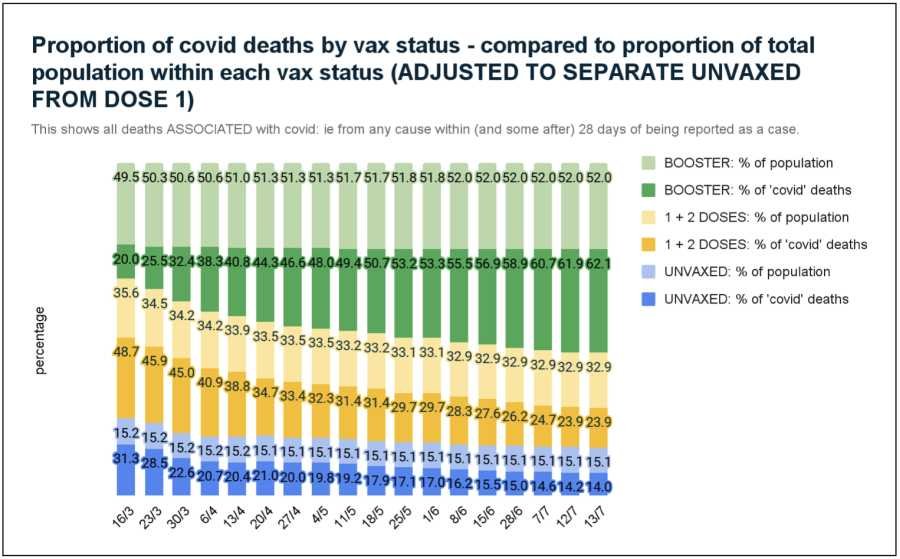
Proportion of covid deaths by vax status (dark colours) with Proportion of total population in each vax status (light shades)

Shows all deaths ASSOCIATED with covid: ie from any cause within 28 days of a + test. (Unfortunately, the MoH does not release the vax status of CONFIRMED covid deaths)

If you read this graph at face value you must conclude as follows:

During the last month boosted individuals have become more vulnerable to death from Covid that they were at the start. Both the vaccinated (excluding the boosted) and unvaccinated groups have become less vulnerable to death through Covid. The increasing vulnerability of the boosted group over time is consistent with the Israeli study. One possible interpretation of the figures is as follows:

The level of natural immunity (due to prior infection) is rising among the unvaccinated as a greater percentage of this group catch and recover from Covid, whereas the more mRNA injections you have had appear to inhibit the acquisition of natural immunity.

However few safe scientific conclusions can be drawn from this table. The New Zealand Ministry of Health does not release sufficient data and the numbers are small. We do not know how many of these deaths were with Covid and how many because of Covid in the various vaccination categories.

We can however segway to figures from the UKHSA. Up until the end of March the UKHSA conveniently provided the case-rates per 100,000 individuals by vaccination status in their vaccine surveillance reports, and the following table has been stitched together by online UK publication The Expose from the case-rate tables found in the Week 3, Week 7 and Week 13 Vaccine Surveillance Reports.

As you can see from the above, the case-rates per 100k have been highest among the triple vaccinated population over these 3 months, except for the 18-29-year-olds in the week 3 report only, and the under 18โ€™s in all 3 months.

However, as in New Zealand, the trend is clear: triple vaccinated individuals are becoming more vulnerable and not exhibiting the acquisition of natural immunity in every age category.

A sufficiently well planned and executed randomised controlled trial with a long duration would reveal what is going on, but neither Pfizer or government health agencies are moving in this direction.

In fact health agencies like the UKHSA are publishing less and less data, possibly because the data is suggesting alarming longer term health consequences of mRNA vaccination.

The lack of complete data at this point actually confounds the issue because it becomes increasingly difficult to sort out what adverse health effects of Covid are due to infection and which to vaccination. If the supposition that the spike protein is a toxin is right, both will have similar effects to varying degrees.

The action point is clear: mRNA vaccination is not working and could be dangerous. In the absence of reliable clinical assessment, and in the presence of concerning data, the use of mRNA vaccines should be paused.

This article is available to download: Where Did the โ€˜scienceโ€™ of the Pandemic Go Wrong and How to Put It Right? (PDF)

Message to NZ Mainstream Media and Scientistsโ€”Change is Coming

World media and government science advisors acknowledge the limitations of the regulatory process for mRNA vaccination.

We shouldnโ€™t understate the naivete of the New Zealand government, media, and scientists during the pandemic.

The tabloid-style stories of severe Covid outcomes, the authoritative voice of Dr. Anthony Fauci (who has financial conflicts of interest), the allure of the word vaccine, and the exaggerated death toll in foreign lands, all combined into a convincing call for immediate and coercive action.

Yet behind the stories, the highly profitable pharmaceutical PR system was running at full steam playing on the fear factor. New Zealand fell head over heels in love. Love knows no reason and that was certainly the case here.

New Zealand is a long way away from the rest of the world. We have a tradition of proud independence and self-sufficiency, but we rolled over and played follow the leader. 

No one in a position of influence struck a note of caution, especially not our Prime Minister.

We instituted the largest public borrowing program in New Zealand history and spent it on a US mega corporation with a poor safety record and a history of punitive malpractice judgements.

The government instituted saturation advertising of vaccine safety and efficacy, and then followed up with mandates, sackings and social exclusion. Our media shouted down those few asking questions.

Times Have Changed

The prestigious and conservative Wall Street Journal (WSJ) has aired concerns about poor regulatory decisions at the US Food and Drug Agency (FDA) about booster shots. They join a growing international chorus of highly qualified and influential voices.

On April 3rd in an opinion piece entitled โ€œFDA Shuts Out Its Own Experts in Authorizing Another Vaccine Boosterโ€ Dr. Marty Makary, a surgeon and public policy researcher at Johns Hopkins University School of Medicine writes:

โ€œThe FDA last week authorized Americans over 50 to get a fourth Covid vaccine dose. Some of the FDAโ€™s own experts disagreed, but the agency simply ignored them.โ€

Eric Rubin, editor in chief of the New England Journal of Medicine (arguably the worldโ€™s most influential medical journal) and a member of the FDA advisory committee on vaccines told CNN last month:

โ€œI havenโ€™t seen enough data to determine whether anyone needs a fourth doseโ€.

Dr. Cody Meissner, also a member of the FDA vaccine advisory committee and chief of pediatric infectious diseases at Tufts Childrenโ€™s Hospital agreed saying:

โ€œthe fourth dose is an unanswered question for people with a normal immune systemโ€

A third member of the committee, Dr. Paul Offit of the Childrenโ€™s Hospital of Philadelphia went further. He told the Atlantic magazine that he advised his 20-something son to forgo the first booster.

The WSJ article described the effect of boosters as fleeting, mild, and short-lived.

Two top FDA officials, Marion Gruber, Director of the FDA Office of Vaccine Research and Review and her deputy Paul Krause, quit the FDA in September last year complaining of undue pressure to authorize boosters and a lack of data to support their use.

Unbelievably, the US Centre for Disease Control (CDC) rubber stamped the FDA decision to approve a second booster without even convening its panel of external independent vaccine experts.

Safety Testing of mRNA Vaccines is Inadequate, Incomplete, and Biased

The Wall Street Journal article sounded a note of alarm saying that neither the CDC nor the US National Institute of Health (NIH) had made a priority of studying vaccine complications.

Moreover, their VAERS data collection and analysis process is incomplete and inadequate. In other words, the safety investigation to date of adverse effects of mRNA vaccination is incomplete and potentially misleading.

The central question raised by the Wall Street Journal opinion piece is why wouldnโ€™t the US regulators wish to undertake accurate and complete investigation of adverse effects of mRNA vaccination?

Have pharmaceutical interests been able to influence decision-making at the FDA to their own commercial advantage at the expense of safety considerations?

A leading authority the British Medical Journal agrees, on March 16 it published an article entitled The illusion of evidence based medicine in which it said:

โ€œEvidence based medicine has been corrupted by corporate interests, failed regulation, and commercialisation of academia.โ€

The Lessons For NZ Are Obvious

We have stifled debate and slavishly followed FDA advice. Now there is a need for reevaluation and debate. We have travelled a long way down a one way street, but it appears to be a dead end.

The triumphant articles published about a survey of vaccine resistant people born in Dunedin was a low point in uncritical NZ mainstream media publishing. We have to regain an objective voice.

Aย paperย published on April 5th in the New England Journal of Medicine found that any measurable protective effect of the fourth inoculation (which in any case, it found, is very small in absolute terms) disappeared after just 8 weeks.

Moreover, aย paperย in the Lancet on April 8th admits that boosters carry a risk of additional side effects.

Both these papers skirted the obvious safety questions in favour of weak praise for vaccine orthodoxy. In contrast, the Wall Street Journal article asked the important question:

Who is actually getting serious about measuring the extent of adverse events, rather than continuing to urge uncritical acceptance of a largely ineffective vaccine?

So far New Zealand media have steered clear of questions. Dr. Ashley Bloomfield has refused to institute mandatory reporting of adverse events following mRNA Covid vaccination and he has excelled at denying vaccine exemptions to those injured by the first shot.

Silence is no longer tenable, in actuality it never was. Questions have to be asked. No ifs or buts. Overseas media outlets of the thinking kind are waking up.

If we canโ€™t face debating rationally with our critics, we are a nation drifting onto the rocks of ignorance and prejudice.

Time for us to wake up.